



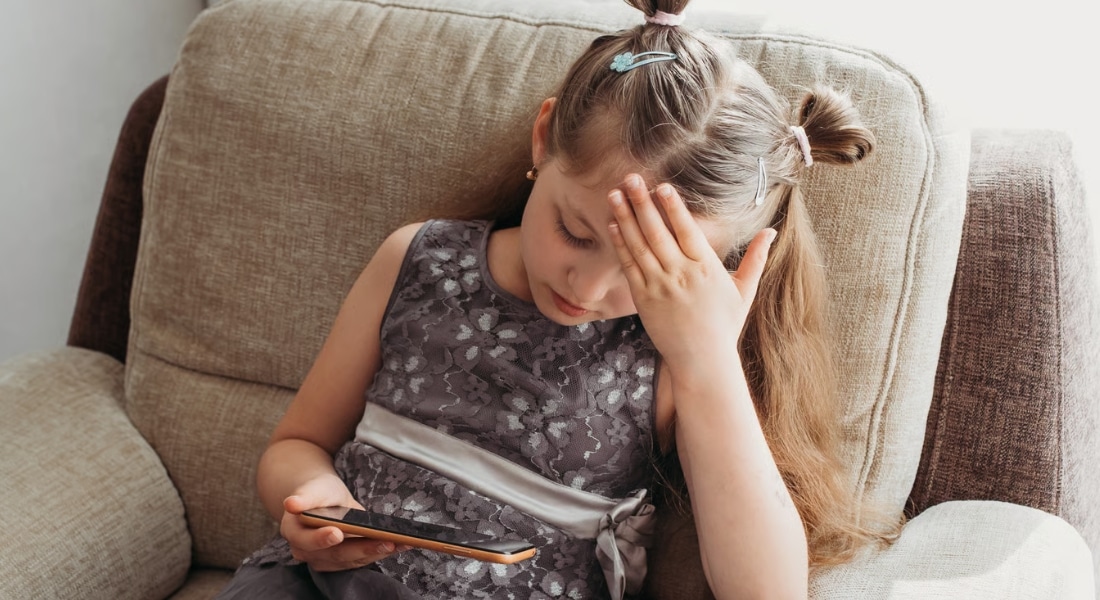
If your child gets a headache after long periods on a screen, you may wonder if screen use is the cause. You may notice headaches with prolonged focusing, glare, fewer breaks or poor posture, but other factors such as migraine, dehydration and poor sleep can also contribute.
There is no single screen-time limit that causes headaches in every child. You can look for your child’s individual pattern, including when headaches start, how long they use screens and whether other symptoms appear.
Key Takeaways
- Longer screen use may be associated with headaches in children, but current evidence does not prove that screens directly cause every headache.
- Digital eye strain can include tired or dry eyes, blurred vision, headache and neck discomfort.
- Long uninterrupted periods of close viewing, poor ergonomics and glare may make symptoms more noticeable.
- Regular breaks, comfortable viewing distance, appropriate text size and sensible lighting can reduce visual discomfort.
- The 20-20-20 rule can be a useful reminder to take breaks, but the evidence for its exact timing is mixed.
- Recurrent headaches should not automatically be blamed on screens; eyesight problems, migraine, sleep, hydration and other causes may need consideration.
- New or worsening headache with neurological or other red-flag symptoms requires medical assessment.
How Can Screen Time Contribute to Headaches?
Screens do not automatically cause headaches, but you may notice symptoms when your child concentrates for long periods without enough breaks. You may also notice tired eyes, blurred vision or neck discomfort from prolonged screen use.
How your child uses the device can also matter, such as holding it too close or leaning towards the screen. If you notice headaches repeatedly start during screen use and improve afterwards, you can use this pattern to make practical changes.
Evidence Note
A 2024 scoping review examined 48 studies of screen use and headache in children and adolescents. Longer duration of screen use showed the clearest association with headache, and computer use was commonly linked with symptoms. However, most studies were observational, so the review could not establish that screen exposure directly causes headaches or define a single safe or harmful screen-time threshold.
What Is Digital Eye Strain?
Digital eye strain can cause your child to experience tired or dry eyes, blurred vision, headaches and neck discomfort after prolonged screen use. You may notice these symptoms when your child spends a long time focusing on a screen without enough breaks.
You can reduce discomfort by giving your child regular breaks, using suitable lighting and keeping the screen at a comfortable distance. If headaches or blurred vision happen often, you should arrange an eye or medical assessment rather than assuming screens are the only cause.
Can Screen Use Reduce Your Child’s Blinking?
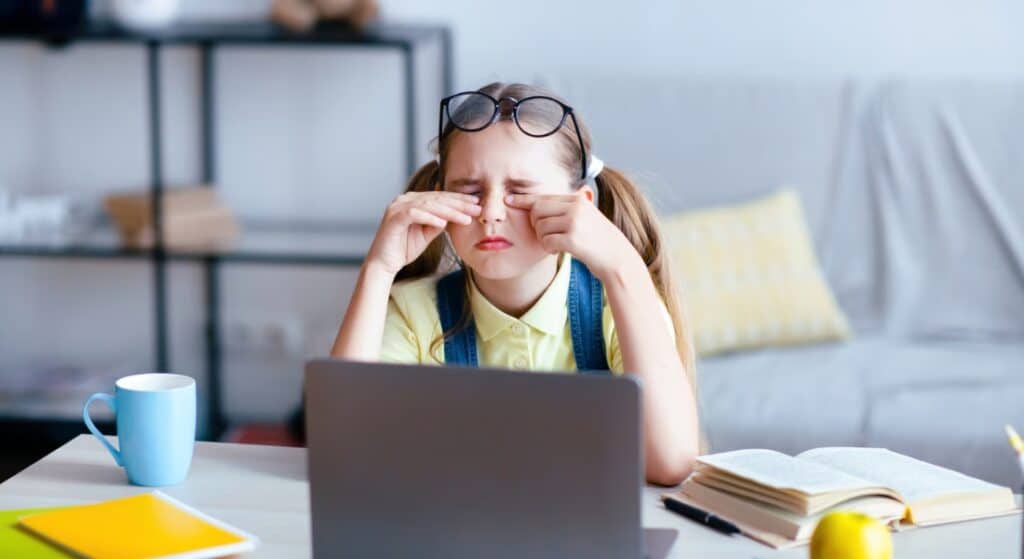
When your child concentrates on a screen, they may blink less often, which can allow their eyes to become dry and uncomfortable. You may notice burning, tired eyes or temporary blurred vision, particularly after long gaming or homework sessions.
You can encourage your child to take regular screen breaks and look away for a while. This gives your child’s eyes a chance to blink normally, rest and stay more comfortable.
Does Holding a Phone Too Close Matter?
Holding a phone or tablet very close increases the amount of near focusing your child’s eyes need to do, particularly when text is small. Prolonged close viewing may contribute to digital eye strain, and headache can occur alongside this discomfort in some children.
You can try increasing the text size or using a larger screen for longer tasks. If your child regularly holds screens unusually close or complains of headaches and eye strain, you should arrange an eye test.
Can Poor Posture Cause a Screen-Related Headache?
Poor posture during screen use can make your child’s neck and shoulder muscles tense, which may contribute to headaches. You may notice this when your child leans towards a laptop, looks down at a phone or stays in one position for too long.
You can help by keeping their screen comfortable to view and encouraging regular movement breaks. If your child has frequent headaches with significant neck pain, you should arrange a medical assessment rather than blaming posture alone.
Can an Eyesight Problem Make Screen Headaches Worse?
Yes, an uncorrected eyesight problem may contribute to eye strain or headaches during reading and screen use. You may notice your child rubbing their eyes, sitting close to screens or struggling to concentrate during homework.
If your child often gets headaches after screen use despite regular breaks, you should arrange an eye test. An eye examination can identify problems such as astigmatism or other refractive errors and determine whether your child may benefit from glasses or other eye care.
Does Screen Brightness or Glare Affect Headaches?

Bright screens, glare and poor room lighting can make your child’s eyes feel uncomfortable during screen use. You may notice headaches or eye strain when reflections make text harder to see, especially during long periods of concentration.
You can reduce discomfort by adjusting the screen brightness and moving it away from direct reflections. If your child also has recurring headaches with nausea or strong light sensitivity, you should discuss these symptoms with a healthcare professional.
Blue-light-filtering glasses are often promoted for screen-related eye strain, but current research has not shown a clear short-term benefit for reducing digital eye-strain symptoms. Most of the trial evidence is in adults, so there is not good evidence that children routinely need blue-light glasses simply because they use screens. Comfortable viewing, suitable lighting, regular breaks and checking for an uncorrected eyesight problem are more practical priorities.
How Often Should Your Child Take Screen Breaks?
Regular breaks can help reduce eye strain and headaches during screen use. You can encourage your child to look away regularly, focus on something in the distance or move around for a short while.
You can also try the widely used 20-20-20 approach, where your child looks at something about 20 feet away for around 20 seconds every 20 minutes. Evidence for this exact timing is mixed, so the important practical principle is to break up prolonged close viewing regularly rather than treating the numbers as a strict medical rule.
Clinical Tip
You do not need to watch the clock rigidly. Encourage your child to break up long periods of close focusing by looking into the distance, blinking normally, changing position and moving around. If one particular activity consistently brings on a headache, record how long your child was using the screen and whether reducing uninterrupted viewing changes the pattern.
How Much Screen Time Is Too Much for a Child?
There is no single screen-time limit that will cause headaches in every child. You may need to consider your child’s age, the type of screen activity, how long they use it continuously and whether they develop symptoms. This refers specifically to headache risk. Separate age-based recommendations may apply to screen use for sleep, development and general wellbeing, particularly in younger children.
You can focus on whether screen use affects your child’s sleep, exercise or wellbeing rather than counting every minute. For headaches, regular breaks and avoiding long periods of uninterrupted close viewing may be more helpful than focusing only on total daily screen time.
Can Screens Trigger Migraine in Children?
Some children with migraine may find screens uncomfortable, particularly when they are already sensitive to light. You may notice that phone, television or computer use makes symptoms more noticeable, but this does not always mean the screen caused the migraine.
You can keep a headache diary to track screen use alongside sleep, meals, hydration and other possible triggers. If your child has recurring headaches with nausea, vomiting or light and sound sensitivity, you should speak with a healthcare professional about possible migraine.
Can Screen Time Cause Headaches by Affecting Sleep?
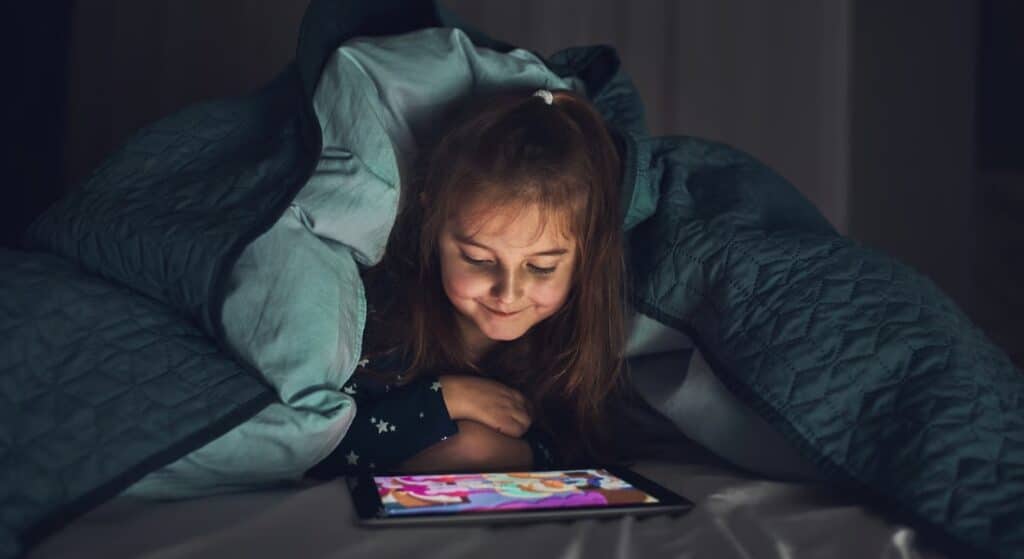
Screen use may contribute indirectly when late or prolonged use delays bedtime or is associated with reduced sleep, as insufficient sleep can itself make headaches more likely in some children. You may notice headaches the following day, especially if your child is also tired, dehydrated or skipping meals.
You can help by creating a predictable evening routine and avoiding recreational screen use from regularly delaying bedtime. You should also look for patterns, such as headaches after late-night gaming compared with headaches that start during daytime screen use.
What Practical Changes Can Reduce Screen-Related Headaches?
You can start with simple changes such as regular breaks, comfortable screen positioning and reducing glare. You can also increase text size, encourage normal blinking and use a larger screen for longer homework sessions.
You should also support your child with regular meals, good hydration, physical activity and enough sleep. If headaches continue despite these changes, you should arrange an appropriate medical or eye assessment.
Screen-Related Pattern or a Reason for Medical Assessment?
| Feature | May fit screen-related discomfort | Needs medical, eye or emergency assessment |
| Timing | Headache mainly appears after prolonged screen/close work | Headaches occur regularly without screen use or are becoming progressively worse |
| Eyes | Tired, dry or temporarily blurred eyes after prolonged focusing | Persistent blurred/double vision, eye pain, new squint or loss of vision |
| Neck/posture | Mild neck or shoulder discomfort after prolonged positioning | Severe or persistent neck pain or other neurological symptoms |
| Response to breaks | Symptoms improve after stopping, moving or resting the eyes | Headache persists or worsens despite practical changes |
| Daily life | Occasional symptoms with long screen sessions | Headaches interfere with school, sleep or normal activities |
| Neurological symptoms | None | Call 999 or go to A&E if your child has a seizure, develops new weakness or numbness, or has difficulty speaking, balancing or walking. |
Should You Keep a Headache Diary?
A headache diary can help you understand whether screens are genuinely linked to your child’s headaches. You can record when the headache starts, what screen they were using, how long they used it and any other symptoms.
You should also note your child’s sleep, meals, hydration, possible triggers and what helps the headache improve. It can also be useful to record whether headaches coincide with significant school stress, learning difficulties, bullying or stress at home, as these factors may be relevant when recurrent headaches are assessed. If you need medical advice, you can take the diary with you to help the clinician understand the pattern.
When Should Your Child Have an Eye Test?
You should consider an eye test if your child often develops headaches during reading, homework or screen use. You may also notice squinting, frequent eye rubbing or sitting unusually close to the television, which can be useful reasons to check their vision.
Your child may not realise that their vision is blurred or unusual because they may assume what they see is normal. If their eyesight is healthy, you can then look with your healthcare professional for other possible causes of recurring headaches.
When Should Screen-Related Headaches Be Medically Assessed?
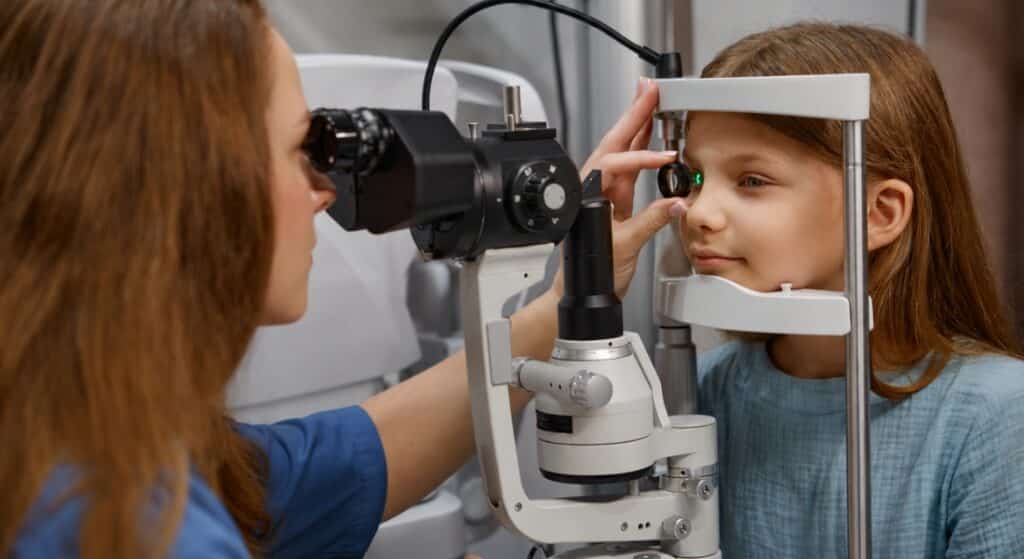
An occasional mild headache may improve with rest and simple changes, but repeated or worsening headaches deserve attention. You should arrange medical advice if headaches are becoming more frequent, worsening, affecting school or limiting normal activities. Seek urgent GP advice or contact NHS 111 if your child has a headache with persistent blurred or double vision or significant eye pain. Recurring headaches during reading or screen use should also be assessed rather than assumed to be caused by screens.
Your child’s doctor may consider their headache pattern, eyesight, sleep, meals and other possible triggers. If headaches continue despite practical changes, seek further medical or eye-care advice so the cause can be assessed and an appropriate management plan discussed. If your child has recurrent headaches, the assessment may involve more than discussing screen habits. NICE recommends checking the back of the eyes with fundoscopy and measuring blood pressure in children with recurrent headache. The clinician may also ask about painkiller use, as excessive use can contribute to medication-overuse headache. NICE advises referral if your child’s headaches are consistently worse when upright and relieved by lying down.
Which Headache Symptoms Should You Never Blame on Screen Time?
You should not assume every headache is caused by screen use, particularly when your child has new, unusual or worsening symptoms. For children under 12, NICE recommends immediate referral for same-day neurological assessment when headache is accompanied by red flags such as waking at night, being present on waking, progressive worsening, vomiting, problems with balance, altered consciousness, or worsening with coughing, sneezing or bending down.
Call 999 or go to A&E if your child develops a headache that starts suddenly and is extremely painful, has a seizure, develops new weakness or numbness, or has difficulty speaking, balancing or walking. Sudden major vision changes, marked confusion or other severe neurological symptoms also need emergency assessment.
UK Guidance Note
For children under 12, NICE recommends immediate referral for same-day neurological assessment if a headache wakes them at night, is present on waking, progressively worsens, is triggered or aggravated by coughing, sneezing or bending down, occurs with fever and features of meningism, vomiting, ataxia, altered consciousness or pervasive lethargy, occurs within five days of a head injury, or is associated with squint or failure of upward gaze.
NICE also advises urgent neurological referral for all children under four who present with headache. If symptoms are potentially life-threatening—for example, if the headache starts suddenly and is extremely painful, or your child has a seizure, new weakness or numbness, or difficulty speaking, balancing or walking—call 999 or go to A&E rather than waiting to see whether reducing screen use helps.
Myth vs Fact
| Myth | Fact |
| Screens always cause headaches in children. | No. Screen use may contribute in some children, but headache also has many other possible causes. |
| There is one number of screen hours that causes headache in every child. | No. Current research has not established a universal headache threshold. |
| The 20-20-20 rule is scientifically proven to work exactly as written. | Not conclusively. Regular breaks are sensible, but evidence for the exact 20-minute/20-second schedule is mixed. |
| Blue-light-blocking glasses are necessary to prevent digital eye strain. | Current evidence has not shown a clear short-term eye-strain benefit from blue-light-filtering lenses, and they are not considered necessary simply because your child uses screens. |
| If a headache begins during screen use, you do not need to consider other causes. | No. Migraine, eyesight problems, sleep, dehydration and other medical causes may also contribute. |
| All screen-related headaches can be managed at home. | No. Frequent, worsening or red-flag headaches need appropriate medical assessment. |
Frequently Asked Questions
1. Can too much screen time cause headaches in your child?
Long periods of screen use may be associated with headaches in some children, particularly when your child focuses for a long time without breaks. Eye strain, glare, poor posture, tiredness and reduced blinking may all make symptoms more noticeable.
2. What is digital eye strain in children?
Digital eye strain can include tired or dry eyes, blurred vision, headaches and neck discomfort after prolonged screen use. Regular breaks, comfortable screen positioning and suitable lighting can help reduce these symptoms.
3. How often should your child take screen breaks?
You can encourage your child to take regular breaks rather than using a screen continuously for long periods. The 20-20-20 approach is one commonly used reminder to take breaks, although the exact timing is not strongly established by research. The main aim is to prevent long periods of uninterrupted close focusing by encouraging your child to look away, blink and move regularly.
4. Can holding a phone or tablet too close cause headaches?
Holding a screen very close can increase the focusing demand on your child’s eyes and may contribute to eye strain. If your child regularly holds devices unusually close, needs very large text or struggles to see clearly, an eye test may be helpful.
5. Can poor posture during screen use cause headaches?
Yes. Sitting with the head bent forward or staying in one position for too long can increase tension in your child’s neck and shoulder muscles. You can help by adjusting the screen position and encouraging regular movement breaks.
6. Can an eyesight problem cause screen-related headache?
An uncorrected eyesight problem may contribute to eye strain or headaches during reading, homework or screen use. If your child frequently squints, rubs their eyes, sits very close to screens or complains of blurred vision, you should arrange an eye test.
7. Can screens trigger migraine in children?
Screens may make migraine symptoms more noticeable in children who are sensitive to light, although this does not necessarily mean the screen caused the migraine. If your child has recurring headaches with nausea, vomiting or sensitivity to light and sound, discuss the pattern with a healthcare professional.
8. How much screen time is too much for your child?
There is no single amount of screen time that causes headaches in every child. You should consider how your child’s screen use affects sleep, physical activity, schoolwork and whether headaches occur after long periods of uninterrupted use.
9. How can you reduce your child’s screen-related headaches?
You can start with regular breaks, comfortable screen positioning, reduced glare and suitable text size. Encouraging good hydration, regular meals, enough sleep and physical activity can also help reduce factors that may contribute to headaches.
10. When should you seek medical advice for your child’s headaches?
Call 999 or go to A&E if your child develops a headache that starts suddenly and is extremely painful, has a seizure, develops new weakness or numbness, or has difficulty speaking, balancing or walking.
Final Thoughts: Helping Your Child Manage Screen-Related Headaches
Screen use may contribute to headaches in some children, particularly during long periods without breaks or when eye strain, poor posture or disrupted sleep are also present. Simple changes such as regular breaks, comfortable screen positioning, good hydration and enough sleep can help.
If your child continues to have frequent or worsening headaches, it is important to look beyond screen time and seek appropriate medical advice. If you’re considering children’s headache treatment in London, you can get in touch with us at London Paediatric Clinic.
References:
- National Institute for Health and Care Excellence (NICE) (2019, updated 2023) Suspected neurological conditions: recognition and referral. NICE guideline NG127. Available at: https://www.nice.org.uk/guidance/ng127
- Langdon, R.L., DiSabella, M.T. and Strelzik, J.A. (2024) ‘Screen time and pediatric headache: A scoping review of the literature’, Headache: The Journal of Head and Face Pain, 64(2), pp. 211–225. Available at: https://pubmed.ncbi.nlm.nih.gov/38299747/
- Lund, J., Berring-Uldum, A., Colak, M. and Debes, N.M.M. (2022) ‘Headache in children and adolescents: The association between screen time and headache within a clinical headache population’, Neuropediatrics, 53(4), pp. 221–226. Available at: https://pubmed.ncbi.nlm.nih.gov/34905787/
- Mataftsi, A., Seliniotaki, A.K., Moutzouri, S. et al. (2023) ‘Digital eye strain in young screen users: A systematic review’, Preventive Medicine, 170, article 107493. Available at: https://pubmed.ncbi.nlm.nih.gov/36977430/
- Kaur, K., Gurnani, B., Nayak, S. et al. (2022) ‘Digital eye strain—A comprehensive review’, Ophthalmology and Therapy, 11(5), pp. 1655–1680. Available at: https://pmc.ncbi.nlm.nih.gov/articles/PMC9434525/
- Demirayak, B., Yılmaz Tugan, B., Toprak, M. and Çinik, R. (2022) ‘Digital eye strain and its associated factors in children during the COVID-19 pandemic’, Indian Journal of Ophthalmology, 70(3), pp. 988–992. Available at: https://pmc.ncbi.nlm.nih.gov/articles/PMC9114593/
- Muntz, A., Turnbull, P.R.K., Kim, A.D. et al. (2022) ‘Extended screen time and dry eye in youth’, Contact Lens and Anterior Eye, 45(5), article 101541. Available at: https://pubmed.ncbi.nlm.nih.gov/34840070/
- Intolo, P., Prasongsansuk, N., Srilabutr, P., Sittichoksakulchai, W., Khutok, K. and Baxter, D.G. (2019) ‘Pain and muscle activity of neck, shoulder, upper back, and forearm during touch screen tablet use by children’, Work, 64(1), pp. 85–91. Available at: https://pubmed.ncbi.nlm.nih.gov/31450531/
- Christopher, J., Priya, Y., Bhat, V. and Sarma, G.R.K. (2022) ‘Characteristics of headache in children presenting to ophthalmology services in a tertiary care center of South India’, Cureus, 14(2), article e21805. Available at: https://pmc.ncbi.nlm.nih.gov/articles/PMC8890450/
- Martin, K.B., Bednarz, J.M. and Aromataris, E.C. (2021) ‘Interventions to control children’s screen use and their effect on sleep: A systematic review and meta-analysis’, Journal of Sleep Research, 30(3), article e13130. Available at: https://pubmed.ncbi.nlm.nih.gov/32567219/