




Taking your baby home from the neonatal unit is a special milestone, but it can also bring mixed emotions. You may feel excited to finally be together at home while also feeling anxious about caring for your baby without the constant support of the neonatal team.
Before discharge, the neonatal team will help you learn how to manage your baby’s individual needs, including feeding, medicines, safer sleep and any equipment they require. Discharge is considered when your baby is medically stable and an appropriate plan for care and support at home is in place. It is still completely understandable to feel anxious, even when you have developed the skills needed to care for your baby.
How the Team Decides Your Baby Is Ready to Go Home
A baby’s readiness for discharge is not usually determined by one target weight or corrected age. The team will consider whether your baby can maintain an appropriate temperature, follow a safe feeding plan, grow steadily and maintain stable breathing, including whether any planned oxygen or other support can be managed safely at home.
The team should discuss the discharge plan with you and make sure that you have received the information, training, equipment and contact details you need. It is still normal to feel uncertain, so tell the team about any task or situation you do not yet feel able to manage.
Understanding Your Discharge Summary and Contact Plan
Before you leave the neonatal unit, you should receive a written discharge summary explaining your baby’s diagnoses, hospital treatment, medicines, feeding plan, equipment and follow-up appointments. You should read it before going home and ask your neonatal team to explain any information or medical terms you do not understand.
| Information You Should Receive | Why It Matters to You |
| Your baby’s diagnoses and treatment | Helps you explain your baby’s medical history to other healthcare professionals |
| Your baby’s feeding plan | Helps you understand which milk, supplements, feeding method and schedule you should follow |
| Your baby’s medicines | Tells you what you should give, how much you should give and when you should give it |
| Your equipment instructions | Helps you use your baby’s oxygen, feeding tube or other equipment safely |
| Your follow-up appointments | Helps you know when and where your baby will be reviewed |
| Your emergency plan | Explains which symptoms should prompt you to seek urgent or emergency help |
| Your contact details | Tells you whom you should contact during the day and outside normal working hours |
You should keep your baby’s discharge summary accessible and take it to appointments or urgent medical assessments. You should also check that your baby’s GP details are correct and contact the relevant service if an expected appointment or home visit does not arrive.
Learning to Care for Your Baby Before Discharge

Before discharge, you should have opportunities to practise feeding, giving medicines, caring for your baby and using any specialist equipment. If your baby needs oxygen, tube feeding or respiratory support, you should receive practical training and have your competence assessed before you go home.
You should also be taught about possible emergencies, what to do if equipment fails or becomes disconnected and whom you can contact at any time. If your baby requires respiratory support at home, your discharge preparation should include training in possible emergencies, equipment problems and infant cardiopulmonary resuscitation for you and, where possible, another regular carer.
Travelling Home Safely
If you travel by car or taxi, your baby should use an appropriately fitted, rear-facing infant car seat. You should read the manufacturer’s instructions and ask your neonatal team for individual advice if your baby is very small, needs oxygen or cannot maintain a suitable position.
Your neonatal unit may recommend an assessment or additional journey planning when your baby has particular medical or positioning needs. You should use the car seat for travel only, remove your baby when you reach your destination and avoid leaving them in the seat for longer than necessary.
Feeding Your Baby at Home
Feeding at home can feel daunting at first, but your discharge plan should explain the type of milk, method of feeding, expected frequency or minimum intake and any supplements or fortifiers your baby needs. Follow the individual plan while also watching how comfortably your baby feeds. Contact your healthcare team if your baby regularly coughs, chokes, becomes breathless, changes colour or takes much less than advised.
If you need help with breastfeeding, expressing or preparing formula safely, contact your healthcare team as early as possible. Do not change your baby’s feeding plan or alter the strength of their milk unless you have been advised to do so by a healthcare professional.
Stop the feed and seek prompt advice if your baby is struggling to breathe or repeatedly coughing or choking. Call 999 if your baby becomes blue or grey, floppy, unresponsive or has severe breathing difficulty.
Monitoring Weight and Growth
Your baby’s weight, length and head circumference may be monitored after discharge. Your healthcare team will assess the pattern across several measurements rather than judging your baby’s progress from one result.
If your baby was moderately premature, their measurements may be plotted using corrected age on a standard UK-WHO chart. If your baby was very premature or needs close growth monitoring, your team may use the neonatal and infant close-monitoring chart up to two years corrected age. You should follow the weighing schedule given by your neonatal team, dietitian or health visitor.
Giving Medicines Safely at Home

If your baby goes home with medicines, make sure you understand what each one is for, how much to give and when it should be given. Ask the neonatal nurse or pharmacist to show you how to measure each dose using an oral syringe, and never change the dose or give extra medicine unless you have been advised to do so by a healthcare professional.
Use a separate labelled oral syringe for each medicine where advised, and do not use a household teaspoon. Check whether the dose is likely to change as your baby gains weight and who is responsible for reviewing it.
Order repeat prescriptions before your supply runs low and store each medicine exactly as instructed. If your baby vomits after a dose, you miss a dose or you are uncertain how much medicine was taken, contact the neonatal team, pharmacist, GP or NHS 111 before repeating it. Giving another full dose without advice could result in too much medicine being given.
Going Home with Oxygen or a Feeding Tube
If your baby goes home with oxygen or a feeding tube, you should receive practical training, written instructions, an emergency plan and contact details for equipment problems. You should not change your baby’s oxygen flow rate unless your clinical team tells you to do so. You should keep oxygen away from smoking, open flames, heat sources, oils and grease, and you should follow every safety instruction provided by your oxygen supplier and neonatal team.
If your baby has a nasogastric tube, check its position before every feed and before giving water or medicine, using the method you were taught. Do not rely on the external tube length alone. If the tube comes out, moves from its usual position or shows a different external length, stop and follow your written plan. Do not use or replace the tube unless its position has been confirmed or you have been trained, assessed and authorised to replace it.
Creating a Safer Sleep Environment
Unless your neonatal team gives you different written medical instructions, you should place your baby on their back for every sleep in their own clear cot or Moses basket with a firm, flat mattress. You should avoid pillows, duvets, cot bumpers, sleep nests, positioners, soft toys and loose items, and you should never sleep with your baby on a sofa or armchair.
You should keep your baby’s sleep space in the same room as you for at least six months, or for at least six months beyond their expected due date if they were premature. Because bed-sharing presents a greater risk when your baby was premature or had a low birth weight, the safest option is to avoid bed-sharing and discuss any concerns about sleep with your neonatal team.
Reducing the Risk of Infection
Babies who were born prematurely or needed neonatal care may be more vulnerable to infections after discharge, so good hand hygiene and sensible precautions are important. Ask anyone who is unwell to delay visiting, avoid exposing your baby to cigarette smoke and follow the cleaning instructions for feeding or respiratory equipment.
You do not need to keep your baby completely isolated, but it is sensible to limit unnecessary contact with people who have coughs, colds or other infectious illnesses. If you are unsure whether your baby needs extra protection against certain infections, ask your neonatal team for advice based on your baby’s individual medical history.
Follow-Up Appointments and Developmental Care
Your baby may have follow-up appointments with a neonatal consultant, paediatrician, health visitor or other specialists, depending on the reason they needed neonatal care. These reviews monitor your baby’s growth, feeding, hearing, vision and development, and for premature babies, progress is usually assessed using corrected age during the first two years.
Keep your baby’s red book, discharge summary and current medicines with you at every appointment, and do not miss routine reviews even if your baby seems well. Contact your healthcare team sooner if your baby loses a skill, uses one side much more than the other, or appears unusually stiff or floppy, as early assessment can provide reassurance or identify support that may be needed.
Vaccinations and Routine Health Care
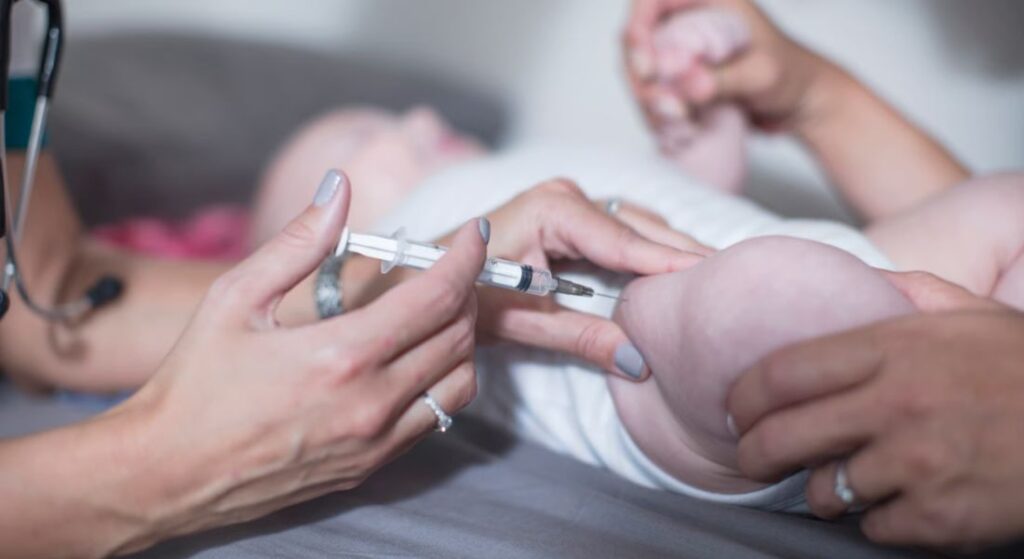
You should register your baby with a GP as soon as possible and make sure that they receive their routine NHS vaccinations. If your baby was born prematurely, they should normally begin their routine vaccinations at eight weeks after their actual date of birth rather than waiting until their expected due date.
Your baby may be eligible for additional vaccination or infection-prevention measures because of their gestation, respiratory condition or other medical history. You should ask your neonatal team which additional protection applies to your baby and who will arrange it.
Settling into Everyday Life at Home
The first few days at home can feel both exciting and overwhelming, especially after spending time in the neonatal unit. Keep life as simple as possible by focusing on feeding, medicines, sleep and follow-up appointments, and do not hesitate to accept practical help from family or friends.
Follow your baby’s cues and remember that irregular feeding and sleeping patterns are common, particularly if they are still young by corrected age. Your baby does not need a hospital-like environment at home—loving, responsive care, warmth and good nutrition are what matter most.
Looking After Your Emotional Wellbeing
Bringing your baby home does not always mean the emotional impact of neonatal care disappears, and it is normal to experience a mixture of relief, anxiety and uncertainty. If these feelings begin to affect your sleep, relationships or daily life, speak to your GP, health visitor or neonatal team, as support is available for you and your family.
Remember that looking after your own wellbeing is an important part of caring for your baby. Over time, your confidence will usually grow through everyday moments together, and support from healthcare professionals or other neonatal families can help you feel less alone.
When to Seek Medical Advice
| What You Notice in Your Baby | What You Should Do |
| Feeding less than usual or repeatedly refusing feeds | You should contact your neonatal team, GP or NHS 111 promptly |
| Unusual sleepiness, irritability or difficulty waking for feeds | You should seek urgent medical advice |
| Fewer or noticeably drier wet nappies | You should arrange prompt assessment because your baby may be dehydrated |
| Worsening jaundice or jaundice with poor feeding or sleepiness | You should seek same-day medical advice |
| Fast, noisy or more difficult breathing | You should arrange urgent assessment; call 999 if your baby is struggling severely |
| A temperature of 38°C or above when your baby is under three months | You should obtain urgent medical assessment |
| Green vomit | You should take your baby for urgent hospital assessment; call 999 if they appear seriously unwell |
| Repeated forceful or projectile vomiting | You should arrange urgent medical assessment |
| Blood in your baby’s vomit or stools | You should seek urgent medical advice |
| Spreading redness, swelling or foul-smelling discharge around the umbilical cord | You should arrange prompt medical assessment |
When Emergency Help Is Required

You should call 999 immediately if your baby stops breathing, has severe breathing difficulty, develops blue or grey lips or tongue, becomes floppy or unresponsive, is extremely difficult to wake, has a seizure or develops a red or purple rash that does not fade when you press it. You should tell the call handler if your baby was premature or uses oxygen, a feeding tube or another medical device.
You should not drive your baby to hospital yourself when they are severely unwell or when you cannot transport them safely. Follow any emergency instructions provided by your neonatal team while you wait for the ambulance.
Myth vs Fact
| Myth | What You Should Know |
| Your baby must reach a particular weight before going home. | Your team considers your baby’s complete medical stability and whether their care can be managed safely at home. |
| Your baby cannot go home with oxygen or tube feeding. | Your baby may go home with specialist support when you have received suitable training and equipment. |
| You should wait until your baby’s due date to begin vaccinations. | Your premature baby should normally receive vaccinations according to their actual age. |
| Your baby should sleep on their front because they did so in the neonatal unit. | You should normally place your baby on their back at home unless your specialist gives you different written instructions. |
| Your home must be kept like a hospital environment. | You need good hygiene and safe equipment care, but your baby also benefits from normal, responsive family life. |
| One disappointing weight result means your baby is not growing. | Your healthcare team assesses your baby’s growth pattern across several measurements. |
| You should repeat a medicine dose whenever your baby vomits. | You should seek professional advice before repeating it because your baby may have absorbed part of the dose. |
| Anxiety means that you are not ready to care for your baby. | You can be well prepared and still feel anxious after leaving the neonatal unit. |
Key Takeaways
- Your baby does not normally need to reach one particular weight before going home.
- You should receive a written feeding, medicine, equipment and follow-up plan.
- You should practise your baby’s care and equipment use before discharge.
- Your baby may be discharged with oxygen or a feeding tube when suitable support has been arranged.
- You should follow your baby’s individual feeding plan and seek advice if feeding becomes difficult.
- You should place your baby on their back in a clear, separate sleep space for every sleep.
- Your premature baby should normally receive vaccinations according to their actual age.
- Your baby’s development may be assessed using corrected age during their first two years.
- You should know which concerns require routine advice, urgent assessment or a 999 call.
- You should ask for help if anxiety after discharge begins to affect your daily life.
Frequently Asked Questions
1. When is your baby ready to go home from the neonatal unit?
Your baby may be ready when they are medically stable, can maintain an appropriate temperature and have feeding, growth and breathing plans that can be managed safely at home. Your baby does not normally need to reach one particular weight.
2. Will your baby need follow-up appointments after discharge?
Yes. Your baby may be reviewed by a neonatologist, paediatrician, neonatal outreach nurse, health visitor, dietitian or another specialist, depending on their needs.
3. Can your premature baby go home with oxygen?
Yes. Your baby may go home with oxygen when they are otherwise stable and you have received appropriate training, equipment, written instructions and community support.
4. How often should your baby be weighed at home?
Your baby’s healthcare team should decide how frequently weighing is needed. You should avoid unnecessary daily weighing unless your team has specifically recommended it because your baby’s growth pattern matters more than one measurement.
5. What should you do if your baby feeds poorly after discharge?
You should seek prompt advice if your baby repeatedly refuses feeds, coughs or chokes, becomes breathless, changes colour, vomits repeatedly, becomes unusually sleepy or has fewer wet nappies.
6. Should your premature baby’s vaccinations be delayed until their due date?
No. Your baby should normally receive routine NHS vaccinations according to their actual age. Their first routine vaccinations are usually offered at eight weeks after their date of birth.
7. How can you reduce your baby’s risk of infection at home?
You should encourage good handwashing, clean feeding and respiratory equipment as instructed, keep your home smoke-free and ask unwell visitors to delay their visit. Anyone with an active cold sore should not kiss your baby.
8. When should you call 999 after your baby comes home?
You should call 999 if your baby stops breathing, has severe breathing difficulty, becomes blue or grey, is floppy or unresponsive, has a seizure or develops a rash that does not fade when pressed.
9. Is it normal for you to feel anxious after bringing your baby home?
Yes. You may feel excited, relieved and anxious at the same time. You should speak to your GP, health visitor or neonatal team if your anxiety becomes overwhelming or affects your sleep, relationships or ability to manage daily life.
10. Who should you contact when you are worried about your baby?
Your discharge plan should explain when you should contact your neonatal outreach team, health visitor, GP, NHS 111 or emergency services. You should use the emergency advice in your plan and call 999 when your baby appears seriously unwell.
Final Thoughts: A Confident Transition from the Neonatal Unit to Home
Bringing your baby home from the neonatal unit is an important milestone for you and your family. You may feel both excited and anxious, but you should leave the unit with an agreed discharge plan, practical training, follow-up arrangements and clear contact details for any concerns.
Your confidence will usually grow as you become familiar with caring for your baby at home. If you would like your baby’s progress reviewed by an experienced neonatologist in London, you can contact London Paediatric Clinic to arrange an appropriate consultation.
References:
- British Association of Perinatal Medicine (no date) Neonatal Outreach Service. Available at: https://www.bapm.org/resources/neonatal-outreach-service
- Cambridge University Hospitals NHS Foundation Trust (no date) Nasogastric tube feeding at home. Available at: https://www.cuh.nhs.uk/patient-information/nasogastric-tube-feeding-at-home/
- Department of Health and Social Care (2026) Delivery of the Healthy Child Programme: Part 2 – health visiting, ages 0 to 5. Available at: https://www.gov.uk/government/publications/delivery-of-the-healthy-child-programme/part-2-health-visiting-ages-0-to-5
- National Institute for Health and Care Excellence (2017) Developmental follow-up of children and young people born preterm. NICE guideline NG72. Available at: https://www.nice.org.uk/guidance/ng72
- National Institute for Health and Care Excellence (2018) Developmental follow-up of children and young people born preterm. Quality standard QS169. Available at: https://www.nice.org.uk/guidance/qs169
- National Institute for Health and Care Excellence (2019) Specialist neonatal respiratory care for babies born preterm. NICE guideline NG124. Available at: https://www.nice.org.uk/guidance/ng124
- National Institute for Health and Care Excellence (2021, updated 2026) Postnatal care. NICE guideline NG194. Available at: https://www.nice.org.uk/guidance/ng194
- NHS (2023) ‘Is your baby or toddler seriously ill?’. Page last reviewed 24 August 2023. Available at: https://www.nhs.uk/baby/health/is-your-baby-or-toddler-seriously-ill/
- NHS (no date) ‘Newborn and baby sleeping advice for parents’. Available at: https://www.nhs.uk/best-start-in-life/baby/baby-basics/newborn-and-baby-sleeping-advice-for-parents/
- Royal College of Paediatrics and Child Health (no date) UK-WHO growth charts: neonatal and infant close monitoring. Available at: https://www.rcpch.ac.uk/resources/uk-who-growth-charts-neonatal-infant-close-monitoring-nicm
- UK Health Security Agency (2025) A quick guide to childhood vaccinations for the parents of premature babies. Updated 23 December 2025. Available at: https://www.gov.uk/government/publications/a-quick-guide-to-childhood-immunisation-for-the-parents-of-premature-babies/a-quick-guide-to-childhood-vaccinations-for-the-parents-of-premature-babies