



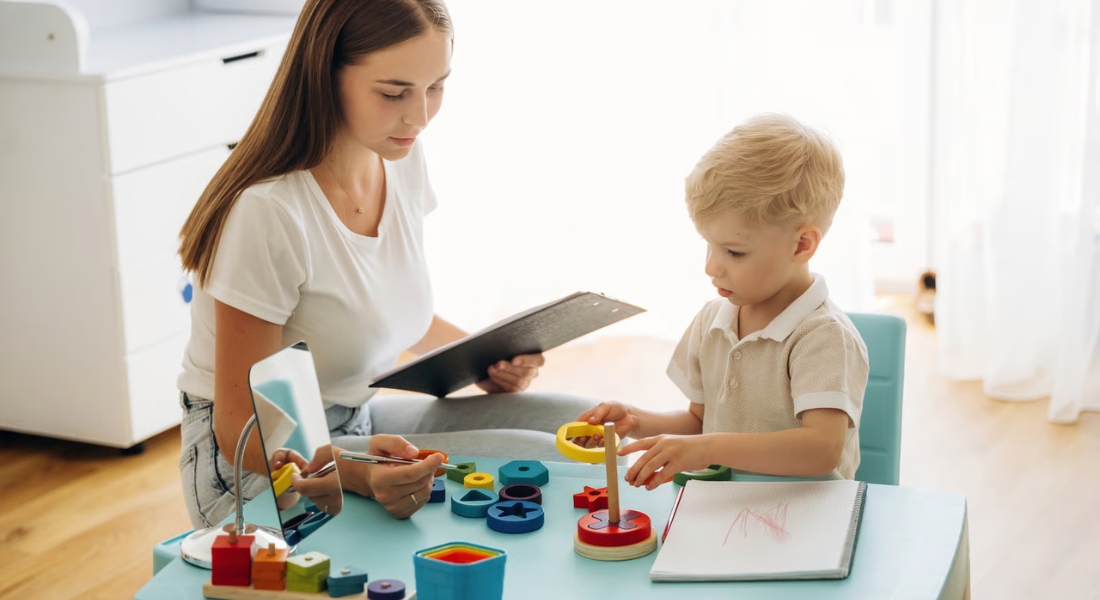
If you have noticed ongoing differences in the way your child communicates, interacts, plays, responds to change or experiences everyday situations, you may wonder whether an autism assessment could be helpful. Autism can present in many different ways, and no single behaviour, such as eye contact, speech delay or not responding to their name, can confirm or rule it out.
A specialist assessment considers the wider pattern of your child’s development, social communication and interaction, behaviours and interests, sensory experiences, strengths and everyday needs. It can help determine whether your child’s developmental profile is consistent with autism, whether another or coexisting condition should be considered and what support may be appropriate.
What Are the Early Signs of Autism?
Possible autism characteristics generally involve differences in social communication and social interaction, alongside restricted or repetitive behaviours, interests or activities. Sensory differences can also form an important part of your child’s overall presentation.
You might notice differences in how your child uses language or gestures, responds socially, plays, manages changes to routines, develops particular interests or responds to sensory experiences. Your child does not need to show every possible characteristic, and no one sign can confirm autism by itself.
Does Your Child Respond to Their Name?
You may notice that your young child does not consistently respond when their name is called, even though they can hear other sounds. This can sometimes be a sign of a difference in social communication, although it does not confirm autism on its own.
Not consistently responding to their name can occur for different reasons, so you should not assume that this behaviour means autism or that hearing difficulties have automatically been excluded. Your specialist can consider hearing, language, attention and the wider pattern of your child’s social communication when deciding whether further assessment is appropriate.
Are There Differences in Eye Contact?

Some autistic children use eye contact less frequently or differently during communication and social interaction. However, eye contact varies considerably, and your child may still make good eye contact, smile and show affection while being autistic.
You should therefore avoid using eye contact as a yes-or-no test for autism. Your specialist will consider it alongside your child’s wider communication, social interaction, behaviour, developmental history and everyday functioning. NICE specifically advises professionals not to rule autism out because a child has good eye contact, smiles or shows affection.
Could Speech and Language Differences Be a Sign?
Your child may start talking later than expected, use language in an unusual way or repeat particular words and phrases. These differences can vary from child to child and may affect how your child communicates with other people.
Speech and language differences do not automatically mean your child is autistic, and typical language milestones do not rule autism out either. Your specialist will consider how your child understands and uses spoken and non-spoken communication, how they use communication socially and, where relevant, how they understand and use their first language.
Does Your Child Find Social Interaction Difficult?
You may notice that your child finds it difficult to join other children in play, maintain two-way conversations or understand how another person is feeling. These social differences can affect how easily your child communicates and builds relationships with others.
Social interaction can vary widely between autistic children, and some may want friendships while still finding the unwritten rules of social interaction challenging. Looking at these patterns alongside your child’s other communication and developmental differences can help you understand whether an assessment may be appropriate.
Does Your Child Prefer Repetitive Activities?
Repeating particular movements, actions, words or activities can be one feature associated with autism. Your child may also become especially interested in particular subjects or prefer to play in highly consistent and predictable ways.
These behaviours do not necessarily mean that your child is autistic on their own. Your specialist will consider them alongside your child’s communication, social interaction, development and other everyday behaviours to understand the wider pattern.
Are Changes to Routine Particularly Difficult?
Some autistic children prefer predictable routines and may become distressed when familiar plans change unexpectedly. Even small changes can sometimes be difficult to manage.
- Predictable routines: Your child may feel more comfortable with familiar activities and schedules.
- Unexpected changes: Sudden changes can cause distress or difficulty adjusting.
- Minor disruptions: Small changes may feel significant to your child.
- Ongoing difficulties: Regular problems with changes may need professional advice.
- Overall pattern: Consider routine difficulties alongside other social and communication differences.
Understanding how your child responds to change can help you recognise their individual needs. A healthcare professional can consider this as part of a wider developmental assessment.
Does Your Child Have Sensory Differences?
Your child may respond very strongly or unusually to sounds, smells, tastes, textures or other sensory experiences. For example, particular noises, foods or clothing textures may feel much more uncomfortable to them than you might expect.
Sensory differences can vary considerably between children and may affect everyday activities at home, school or elsewhere. When these responses occur alongside other developmental, communication or social differences, they can be useful information to discuss as part of a wider assessment.
Can Autism Signs Be Different in Older Children?
Autistic characteristics may become easier to recognise as your child gets older and social, educational and organisational demands increase. Difficulties that were less obvious in early childhood may become more noticeable when friendships, conversations, flexibility and independence become more complex.
Your older child may also have developed coping strategies or may be in a supportive environment that makes some characteristics less visible. This can mean that autism is recognised later even though the underlying developmental differences were present earlier.
Can Autism Be Missed in Girls or Verbally Able Children?
Yes. NICE advises that autism may be under-recognised in girls and may also be missed in children and young people who are verbally able. Your child may communicate fluently or appear to manage some social situations successfully while still experiencing significant differences in social communication, flexibility, sensory experiences or everyday functioning.
In older children and young people, autistic characteristics may sometimes have been less obvious because of coping strategies or a supportive environment. A specialist should therefore consider your child’s developmental history, current experiences and the effort required to manage everyday situations rather than judging solely by how capable they appear during one interaction.
Does Every Autistic Child Show the Same Signs?
No, autism can look very different from one child to another, and your child does not need to show every possible sign. The way autism affects communication, social interaction, behaviour and everyday experiences can vary considerably between children.
This means you should not use a checklist alone to decide whether your child is or is not autistic. Your child may make good eye contact, show affection, engage in pretend play or have developed spoken language at the expected age and still meet the diagnostic criteria when their complete developmental profile is considered.
When Should You Consider an Autism Assessment?

You should consider professional advice if you have ongoing concerns about your child’s communication, social interaction, behaviour, flexibility, sensory experiences or everyday functioning. Professionals will consider how long these characteristics have been present, their impact across different settings and whether another explanation may be involved.
When an Autism Assessment May Be Appropriate
| Area of Concern | What You May Notice | Why It Matters | What Professionals Consider |
| Communication | Differences in speech, language or understanding others | May affect everyday interactions | Your child’s communication development and pattern |
| Social interaction | Difficulty understanding or responding to social situations | May affect friendships and relationships | How your child interacts across settings |
| Behaviour and flexibility | Strong preference for routines or difficulty with change | May make everyday changes challenging | Persistent patterns and their impact |
| Sensory experiences | Unusual sensitivity or seeking of sounds, textures, lights or other sensations | May affect comfort and participation | How sensory differences affect daily life |
| Development | Ongoing differences in development or behaviour | May indicate a need for further assessment | Developmental history and current functioning |
| Family impact | Difficulties affect routines or family life | Shows the wider effect of your child’s needs | Impact on your child and family |
| Parent or carer concerns | You remain concerned even if others do not share your concerns | Your observations are important to assessment | Professionals should take your concerns seriously |
What If Your Child Loses Skills They Previously Had?
If your child loses language, social or motor skills that they previously had, you should tell a healthcare professional rather than simply waiting to see whether the difficulty improves. Developmental regression needs appropriate medical assessment because there can be different possible explanations.
NICE recommends referral to an autism team when a child younger than 3 years loses language or social skills. If your child is older than 3 and loses language, or loses motor skills at any age, NICE recommends assessment by a paediatrician or paediatric neurologist first, with autism-team referral when appropriate.
Should You Speak to Your Child’s School or Nursery?
Teachers and nursery staff can provide useful observations about how your child communicates, plays, learns and interacts outside the home. Their experiences can help you understand how your child responds to social situations, routines and everyday activities in a different environment.
School or nursery information can help show how your child manages in a different social and learning environment, but a difference between what you see at home and what staff observe does not automatically rule autism out. Your concerns should still be taken seriously, and the specialist can gather additional information or observations when reports from different settings do not agree.
What Happens During an Autism Assessment?
Your child’s assessment should include a detailed developmental and medical history, discussion of your concerns and your child’s experiences at home and in education, and assessment through interaction and observation of their social communication and behaviour. Autism-specific tools or structured activities may also be used to gather information, but no individual tool should determine the diagnosis by itself.
NICE also recommends a physical examination, consideration of alternative and coexisting conditions and development of a profile covering your child’s strengths, skills, difficulties and support needs. With appropriate consent, information from school or nursery, previous assessments and relevant hearing, vision, health or social-care records may also contribute to the assessment.
Is There a Single Test for Autism?

No. There is no single blood test, scan, questionnaire or autism-specific assessment tool that can diagnose your child by itself. Your specialist may use structured questionnaires or diagnostic tools to gather information, but the results must be interpreted within the complete clinical assessment.
A screening or identification tool can sometimes help professionals decide whether referral should be considered, but a positive score does not prove that your child is autistic and a negative result does not rule autism out. Your specialist should combine information from all relevant sources with clinical judgement.
Can an Assessment Identify Other Difficulties?
Yes. An autism assessment should also consider whether another condition could better explain some of your child’s difficulties and whether they have additional needs alongside autism. This wider assessment is important because more than one developmental, mental-health or medical condition can occur at the same time.
Depending on your child’s presentation, professionals may consider ADHD, anxiety, learning or language difficulties, developmental coordination difficulties, tic disorders, epilepsy, sleep problems and hearing or vision difficulties, among other possibilities. Any additional assessment or referral should be based on your child’s individual history and clinical findings.
How Can an Autism Assessment Help Your Child?
An assessment can help you understand your child’s strengths, developmental differences and support needs, whether or not autism is diagnosed. Your child may still benefit from appropriate educational, developmental or healthcare support if the assessment identifies needs that do not meet the full diagnostic criteria for autism.
If you have ongoing concerns, arranging a specialist autism assessment for children in London can help you explore your child’s development in greater detail. The assessment can help clarify whether their developmental profile is consistent with autism, whether another or coexisting condition should be considered and which next steps may be appropriate.
Myth vs Fact
| Myth | What You Should Know |
| Your child cannot be autistic if they make good eye contact. | Your child’s good eye contact does not rule autism out. |
| Your child cannot be autistic if they are affectionate. | Your child may smile and show affection while still being autistic. |
| Typical early speech means your child cannot be autistic. | Your child’s typical language milestones do not exclude autism. |
| One autism questionnaire can diagnose your child. | Your child’s diagnosis requires a comprehensive clinical assessment. |
| A negative screening score means your child is not autistic. | Your child’s negative screening result cannot reliably rule autism out. |
| School must see exactly the same difficulties that you see at home. | Your child’s presentation may differ between environments, and your concerns still need to be considered. |
| Verbally able children are easy to recognise as autistic. | Your child’s autism may be missed even when they use spoken language fluently. |
| Only girls can mask autism. | Girls may be more likely to mask, but children of any sex can develop strategies that make characteristics less noticeable. |
| Every child needs genetic testing or a brain scan for autism. | Your child does not routinely need medical investigations simply to diagnose autism. |
| No autism diagnosis means the assessment found nothing useful. | Your child’s assessment can still identify strengths, other conditions and support needs. |
Key Takeaways
- Your child does not need to show every commonly described autism characteristic.
- Your child’s good eye contact, affection, pretend play or typical early language milestones do not rule autism out.
- Your child’s autistic characteristics may become easier to recognise as social and educational demands increase.
- Your child may use coping or masking strategies that make some differences less obvious.
- Your concerns remain important even if school, nursery or another professional does not notice the same difficulties.
- Your child may be autistic alongside having ADHD, anxiety, language difficulties, epilepsy or another condition.
- Your child should not be diagnosed using one questionnaire, screening score or structured autism tool.
- Your child’s assessment should consider their developmental and medical history, communication, behaviour, physical health, strengths and support needs.
- Your child does not routinely need blood tests, scans or genetic testing simply because they are having an autism assessment.
- If your child loses previously acquired language, social or motor skills, you should tell a healthcare professional promptly.
UK Guidance Note
NICE recommends that your child’s autism diagnostic assessment should be comprehensive and carried out through an appropriately skilled multidisciplinary autism team. It should include developmental and medical history, assessment of social communication and behaviour, a physical examination, consideration of alternative and coexisting conditions and a profile of your child’s individual strengths, skills, difficulties and support needs.
Autism should not be ruled out simply because your child makes good eye contact, smiles, shows affection, takes part in pretend play or achieved typical language milestones. Autism-specific questionnaires and structured diagnostic tools can contribute useful information, but no individual tool should be used on its own to confirm or exclude autism.
Frequently Asked Questions
1. What signs might make you consider an autism assessment for your child?
You may notice persistent differences involving social communication and interaction, play, flexibility, repetitive behaviours or interests and sensory experiences. No one sign confirms autism, so your child’s overall developmental pattern needs to be considered.
2. Does your child need poor eye contact to be autistic?
No. Your child may make good eye contact, smile and show affection and still be autistic. NICE specifically advises professionals not to exclude autism for these reasons.
3. Can delayed speech indicate autism in your child?
It can occur in autistic children, but speech delay has many possible explanations. Your child can also be autistic despite achieving typical language milestones, so communication needs to be considered more broadly.
4. Can your child be autistic if school has no concerns?
Yes. Your child’s presentation may vary between environments, and some children adapt or mask more effectively in particular settings. NICE says your concerns should be taken seriously even when they are not shared by other people.
5. What should you do if your child loses language or other skills?
You should tell a healthcare professional. NICE recommends autism-team referral for language or social regression in a child younger than 3, while language regression after age 3 or motor regression at any age should first be assessed by a paediatrician or paediatric neurologist.
6. Who carries out your child’s autism assessment?
Your child’s assessment should involve appropriately trained professionals. NICE’s core autism-team model includes a paediatrician and/or child and adolescent psychiatrist, a speech and language therapist and a psychologist, with access to other specialists when required.
7. Is there one test that can diagnose autism in your child?
No. Your child’s specialist may use questionnaires or structured autism tools, but no individual test should make or rule out the diagnosis. The decision is based on information from multiple sources and clinical judgement.
8. Does your child need blood tests or a brain scan during an autism assessment?
Not routinely. Medical investigations are considered when your child’s history, examination or other clinical findings provide a reason for them.
9. Can your child’s assessment identify ADHD or another condition as well?
Yes. Your specialist should consider conditions that may coexist with autism or offer another explanation, including ADHD, anxiety, language or learning difficulties, epilepsy, hearing or vision problems and other developmental or health needs.
10. What happens if your child is not diagnosed with autism?
Your child’s assessment can still identify important strengths, difficulties and support needs. Appropriate services or further assessment can be recommended according to their individual profile even when they do not meet the diagnostic criteria for autism.
Final Thoughts: Understanding When an Autism Assessment May Help
If you have noticed ongoing differences in your child’s communication, social interaction, behaviour, sensory responses or ability to manage everyday situations, you do not need to rely on one sign to decide whether to seek advice. A specialist assessment can bring together your observations, your child’s developmental history and information from school or nursery to build a clearer picture of their individual strengths and needs. If you’re considering autism assessment for children, you can get in touch with us at London Paediatric Clinic.
References:
- National Institute for Health and Care Excellence (2011, updated 2017) Autism spectrum disorder in under 19s: recognition, referral and diagnosis. NICE guideline CG128. Available at: https://www.nice.org.uk/guidance/cg128/
- National Institute for Health and Care Excellence (2013, updated 2021) Autism spectrum disorder in under 19s: support and management. NICE guideline CG170. Available at: https://www.nice.org.uk/guidance/cg170/
- NHS (2026) ‘What is autism?’. Page last reviewed 6 May 2026. Available at: https://www.nhs.uk/conditions/autism/what-is-autism/
- NHS (2026) ‘Signs of autism in children’. Page last reviewed 6 May 2026. Available at: https://www.nhs.uk/conditions/autism/signs-in-children/
- NHS (2026) ‘Autism assessments’. Page last reviewed 6 May 2026. Available at: https://www.nhs.uk/conditions/autism/assessments/
- Great Ormond Street Hospital for Children NHS Foundation Trust (no date) ‘Autism Spectrum’. Available at: https://www.gosh.nhs.uk/conditions-and-treatments/conditions-we-treat/autism/
- Fulceri, F., Caruso, A., Micai, M., Gila, L., Tancredi, R., Fatta, L.M., Galati, G., d’Amico, R., Schünemann, H.J., Balduzzi, S., Cinquini, M. and Scattoni, M.L. (2025) ‘Autism diagnosis in children and adolescents: A systematic review and meta-analysis of test accuracy’, Neuroscience & Biobehavioral Reviews, 173, article 106164. Available at: https://www.sciencedirect.com/science/article/abs/pii/S0149763425001642