




You may assume that any paediatrician can provide the same care, but you can see different specialists depending on your child’s needs. You may start with a general paediatrician if your child’s symptoms are unclear, while your child may need a specialist if they have an established condition.
You can therefore focus on what your child needs rather than choosing the most specialised doctor. The right paediatrician for your child is the one whose expertise best matches their current healthcare needs.
Why Do People Assume All Paediatricians Do the Same Job?
You may think all paediatricians have the same expertise because you see them caring for children, but your child’s needs can determine which type of paediatrician is most suitable. You may see a general paediatrician for broad concerns or a specialist for a specific condition.
You can therefore expect different paediatricians to have different day-to-day expertise. When you choose care for your child, you should focus on the doctor’s experience with your child’s particular needs rather than the job title alone.
What Does a General Paediatrician Do?
Your child may benefit from a general paediatric assessment when their symptoms do not point to one clear condition. You can discuss several concerns together, such as tiredness, headaches, abdominal symptoms, appetite or changes in weight.
Your paediatrician can look at your child’s overall health, growth and development, arrange appropriate investigations and decide whether your child needs input from another specialist. You do not need to choose a narrow specialty before your child’s symptoms are fully assessed.
How Do Paediatricians Become More Specialised?
You may notice that paediatricians develop different expertise as they progress through training. If your child’s symptoms are broad or unclear, you can start with a general paediatrician; if your child has a specific condition, they may benefit from a paediatric specialist with focused expertise in that area.
You should therefore look at what your child needs rather than assuming every paediatrician has the same experience. You can ask which specialist is most appropriate for your child’s condition and what expertise they have in that area.
What Does a Paediatric Cardiologist Do Differently?
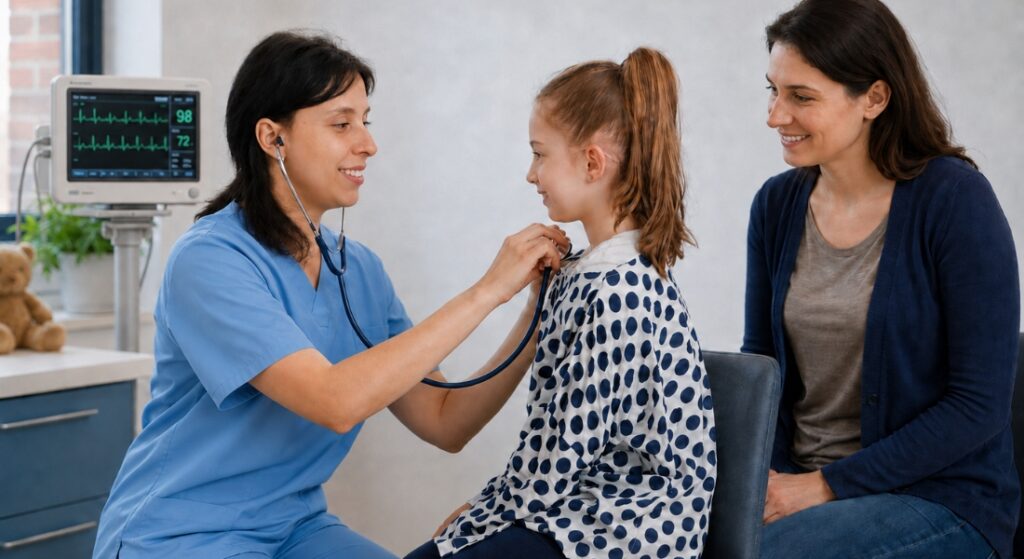
Your child may need assessment by a paediatric cardiologist if they have a suspected or known heart condition. You can expect them to assess conditions such as congenital heart problems, abnormal heart rhythms and cardiomyopathies using specialist heart tests.
You do not need to assume that every heart murmur, chest discomfort or fainting episode means your child needs cardiology. You can first speak to your GP or general paediatrician, who can assess your child’s symptoms and decide whether your child needs specialist heart care.
What Does a Paediatric Neurologist Do?
Your child may need a paediatric neurologist if they have a condition affecting the brain, nerves, spinal cord or muscles. You can seek their expertise for conditions such as epilepsy, movement disorders or neuromuscular problems.
You do not need to assume that every headache, tic or fainting episode requires a neurologist. You can first discuss your child’s symptoms with your GP or general paediatrician, who can decide whether your child needs specialist neurological assessment.
What Does a Paediatric Gastroenterologist Do?
Your child may need paediatric gastroenterology, hepatology or nutrition input if they have a complex digestive, liver, feeding or nutritional condition. You can seek their expertise for conditions such as inflammatory bowel disease, complicated coeliac disease, intestinal failure or complex liver disease.
You do not need to assume that every episode of abdominal pain or constipation requires a specialist. You can first speak to your GP or general paediatrician, who can assess your child’s symptoms, growth and examination and decide whether gastroenterology care is needed.
What Does a Paediatric Endocrinologist Do?
Your child may need paediatric endocrine assessment if they have concerns involving growth, puberty, hormones or diabetes. You can seek specialist advice if your child’s growth pattern is unusual, puberty is very early or delayed, or tests suggest a hormonal problem.
You do not need to assume that being shorter than other children means your child needs an endocrinologist. You can first speak to your GP or general paediatrician, who can review your child’s growth, family pattern and development before deciding whether specialist care is needed.
What Makes a Neonatologist Different from Other Paediatricians?
Your baby may need care from a neonatologist if they are premature or become unwell around birth. They may receive specialist care for breathing, feeding, infection or other complications that require close newborn monitoring.
You may also have antenatal discussions with a neonatologist if your baby is expected to need specialist care after birth. If your baby was very premature or seriously unwell, they may need developmental or specialist follow-up after leaving neonatal care.
What About Respiratory Medicine and the Other Paediatric Sub-specialties?

You may come across many paediatric specialists, including doctors focusing on breathing, kidneys, rheumatology, allergy, immunology, infections, cancer and intensive care. You can also find specialists in inherited metabolic conditions, neurodisability, palliative care and community child health.
You should not assume your child needs a highly specialised doctor for every condition. If your child’s health involves several areas, you may need different specialists to work together so your child receives the right care.
Are All Children’s Specialists Formally RCPCH Paediatric Sub-specialists?
No. You may find paediatric terminology confusing because the RCPCH’s 17 paediatric sub-specialties do not include every specialist who treats children. Your child may see a specialist in cardiology, dermatology, psychiatry, surgery or another area depending on their needs.
You do not need to understand every training pathway yourself. You can focus on whether the doctor you see has the right training and experience to assess your child’s specific health concern.
UK Guidance Note
The RCPCH currently recognises 17 paediatric sub-specialties within its paediatric training pathway. However, several specialties that provide specialist care to children follow different UK training pathways. These include paediatric cardiology, dermatology, psychiatry, radiology, surgery, urology and clinical genetics. This means that a child-focused specialist can be appropriately trained without being one of the 17 RCPCH paediatric sub-specialists.
How Do Different Types of Paediatric Expertise Compare?
| Type of clinician/training | What it generally means |
| General paediatrician | Provides broad assessment and management across a wide range of health concerns in babies, children and young people. |
| RCPCH paediatric sub-specialist | Completes approved focused training in an RCPCH paediatric sub-specialty and is eligible for the approved sub-specialty to be recognised on their GMC Specialist Register entry. |
| Paediatrician with an RCPCH SPIN module | Has completed additional structured RCPCH training and experience in a particular clinical area, but SPIN training is not equivalent to formal sub-specialty training or GMC sub-specialty accreditation. |
| Child-focused specialist outside the RCPCH pathway | Provides specialist children’s care through another recognised UK specialty pathway, such as paediatric cardiology, dermatology or surgery. |
| Multidisciplinary team | Brings together different doctors and healthcare professionals when a child’s needs cross more than one clinical area. |
A paediatrician may also describe a clinical “special interest” based on their experience or current work. This does not automatically mean they have completed an RCPCH SPIN module or formal sub-specialty training.
What Is the Difference Between a Sub-specialty and a Special Interest?
You may see a paediatrician describe a special interest or mention an RCPCH Special Interest (SPIN) module. A SPIN provides additional structured training and experience in a particular clinical area, allowing a paediatrician to develop additional expertise while remaining distinct from formal paediatric sub-specialty training.
A SPIN is not equivalent to completing an RCPCH sub-specialty programme and does not itself provide GMC sub-specialty accreditation. When choosing care for your child, you can consider the doctor’s formal training, current clinical work and experience with problems similar to your child’s rather than relying on the title alone.
Is a General Paediatrician Usually the Best Place to Start?

You may benefit from seeing a general paediatrician when you do not yet know what is causing your child’s symptoms. You can discuss several concerns together, such as tiredness, abdominal discomfort, poor appetite and headaches, rather than choosing a narrow specialist too early.
Your paediatrician can look at your child’s overall health and decide which area needs further investigation. If your child’s condition becomes clearer, you can then be referred to the most appropriate specialist.
When Might Going Directly to a Sub-specialist Make More Sense?
Your child may need a specific paediatric specialist when their diagnosis is already clear. For example, you may be referred directly to cardiology for a known heart condition or neurology for an established complex epilepsy syndrome.
If your child already has clear test results or a confirmed condition, direct referral to the relevant specialist may be appropriate, depending on the NHS or private-care pathway involved. However, when the cause of your child’s symptoms is unclear, they may benefit from a broad paediatric assessment first.
Can Your Child Need More Than One Paediatric Specialist?
Yes. You may find that your child’s condition involves more than one specialty. For example, your child may need neurology, respiratory care, nutrition or physiotherapy for different aspects of the same condition.
You should know which clinician is coordinating your child’s overall care and whom you should contact about specific concerns. When several teams are involved, good communication can help your child receive coordinated care and can make it clearer which team is responsible for different aspects of their treatment.
Does Seeing a Sub-specialist Mean Your Child Has a More Serious Condition?
Not necessarily. Your child may be referred to a specialist because they need specific expertise, investigations or a second opinion, not simply because their condition is serious.
You should not assume that seeing a cardiologist or neurologist means your child has a severe condition. Your healthcare team can explain why your child has been referred and what the specialist needs to assess.
How Do You Choose the Right Type of Paediatrician?

Choosing the right paediatrician depends mainly on your child’s symptoms, diagnosis and individual healthcare needs. You do not always need the most specialised doctor first, especially when the cause of your child’s symptoms is still unclear.
- Unclear or Multiple Symptoms: Your child may benefit from a general paediatrician who can assess several concerns together and consider their overall health.
- Known Medical Condition: If your child already has a confirmed diagnosis, they may need a specialist with experience in that particular area.
- Relevant Training and Experience: You can look at the paediatrician’s recognised training, clinical interests and experience with conditions similar to your child’s.
- Need for Further Referral: A general paediatrician can arrange initial tests and refer your child to a sub-specialist if more focused expertise is needed.
- Complex Healthcare Needs: If your child needs several specialists, you can ask which clinician will coordinate their overall care and help keep treatment joined up.
The right choice is not necessarily the paediatrician with the narrowest specialty, but the one whose expertise best matches your child’s current needs. If you are unsure where to start, your GP or general paediatrician can help you decide which type of specialist is most appropriate.
Clinical Tip
When reviewing a paediatrician’s profile, look beyond the specialty name alone. Consider their formal training, current clinical work and experience with your child’s particular problem. If you are unsure which type of specialist is appropriate, your GP or a general paediatrician can help guide the next referral.
Myth vs Fact
| Myth | Fact |
| All paediatricians have exactly the same expertise. | No. General paediatricians and specialists may have different training, clinical roles and areas of expertise. |
| The most specialised doctor is always the best first choice. | No. A general paediatrician may be more appropriate when your child’s symptoms are broad or unclear. |
| Every child-focused specialist is one of the 17 RCPCH paediatric sub-specialists. | No. Some specialties, including paediatric cardiology and surgery, follow different UK training pathways. |
| A “special interest” always means formal sub-specialty accreditation. | No. RCPCH SPIN training provides additional expertise but is distinct from formal sub-specialty training. |
| Seeing more than one specialist means your child’s condition must be severe. | No. Different specialists may simply be needed when a condition affects several aspects of health. |
| A specialist referral confirms a serious diagnosis. | No. Referral may be made for focused assessment, investigations or another clinical opinion. |
Key Takeaways
- Not all paediatricians perform the same role or have the same specialist expertise.
- General paediatricians provide broad assessment and can be particularly useful when your child’s symptoms are unclear or involve several areas.
- Your child may be referred to one of 17 recognised RCPCH paediatric sub-specialties, while some child-focused specialists follow different UK training pathways.
- RCPCH Special Interest (SPIN) modules provide additional training but are not equivalent to formal sub-specialty accreditation.
- A specialist referral does not automatically mean your child has a serious condition.
- Children with complex needs may benefit from several specialists working together.
- The most appropriate doctor is the one whose training and experience best match your child’s current needs.
Frequently Asked Questions
1. Do all paediatricians do the same job?
No, paediatricians can have different areas of expertise. You may see a general paediatrician for broad or unclear concerns, while your child may need a specialist for a specific condition.
2. What information is useful when you first see a general paediatrician?
Bring details of your child’s symptoms, when they started, any previous test results, clinic letters and an up-to-date medicines list where relevant. It can also help to explain how the problem affects your child’s sleep, school, eating, activity or everyday life.
3. When might your child need a paediatric sub-specialist?
Your child may need focused specialist care when they have a known or suspected condition requiring additional expertise. Formal RCPCH paediatric sub-specialties include areas such as neurology, respiratory medicine, nephrology and gastroenterology, while other child-focused specialties such as paediatric cardiology follow different UK training pathways.
4. What information might help decide whether your child needs paediatric cardiology?
Tell your GP or paediatrician about symptoms such as fainting, palpitations, exercise-related symptoms or any known heart condition, together with relevant family history and previous test results. They can then decide whether specialist cardiac assessment is appropriate.
5. What information can help before a paediatric neurology referral?
Record what you have noticed, how often it happens and how long episodes last. Videos can sometimes be useful for intermittent movements or episodes if they can be recorded safely, and relevant clinic letters or previous test results can help the specialist understand what has already been assessed.
6. Can your child need more than one paediatric specialist?
Yes, your child may need several specialists if their condition affects different areas of health. You can ask your healthcare team which clinician coordinates your child’s overall care and who you should contact about specific concerns.
7. Does seeing a paediatric sub-specialist mean your child has a serious condition?
No, a specialist referral does not necessarily mean your child has a serious condition. Your child may be referred because they need specific expertise, further investigation or another clinical opinion.
8. What should you check when a paediatrician lists a “special interest”?
Look at the doctor’s formal training, current clinical work and experience with children who have concerns similar to your child’s. A special interest does not automatically mean formal RCPCH sub-specialty or SPIN accreditation, so you can check what training the description actually refers to.
9. Should you start with a general paediatrician if your child’s symptoms are unclear?
Often, yes. If the cause of your child’s symptoms is unclear, your child may benefit from a broad assessment first, allowing the paediatrician to decide whether further investigation or specialist referral is appropriate.
10. What should you look for when comparing paediatric specialists?
Consider whether the doctor’s current clinical work and recognised training match your child’s problem. If your child’s diagnosis is unclear, broad general paediatric expertise may be more useful initially than choosing the narrowest specialist available.
Final Thoughts: Finding the Right Paediatrician
Not all paediatricians have the same expertise. You may start with a general paediatrician for unclear or multiple concerns, while a specialist may be more appropriate when your child has a specific condition.
Choosing the right care means considering your child’s needs, along with the paediatrician’s training and experience. If you’re looking for a paediatrician in London, you can get in touch with our team at London Paediatric Clinic.
References:
- Royal College of Paediatrics and Child Health (RCPCH).Paediatric sub-specialties.https://www.rcpch.ac.uk/education-careers/apply-paediatrics/sub-specialties
- Royal College of Paediatrics and Child Health (RCPCH).General paediatrics – specialty level training.https://www.rcpch.ac.uk/education-careers/apply-paediatrics/sub-specialties/general-paediatrics
- Royal College of Paediatrics and Child Health (RCPCH).Introducing paediatric training –a world of opportunities.https://www.rcpch.ac.uk/education-careers/choose-paediatrics/introducing-training
- Royal College of Paediatrics and Child Health (RCPCH).Special Interest (SPIN) modules.https://www.rcpch.ac.uk/education-careers/training-assessment/SPIN-modules
- British Congenital Cardiac Association (BCCA).Paediatric Cardiology.https://www.bcca-uk.org/paediatric-cardiology
- Royal College of Paediatrics and Child Health (RCPCH).Paediatric neurology – sub-specialty.https://www.rcpch.ac.uk/education-careers/apply-paediatrics/sub-specialties/neurology
- Royal College of Paediatrics and Child Health (RCPCH) (2024).Multidisciplinary teams in paediatrics – a guide.https://www.rcpch.ac.uk/resources/multidisciplinary-teams-paediatrics-guide