




If you are worried about your child’s health, one of the first questions you may ask is whether you need to see your GP before booking a paediatrician. Many parents feel unsure about the referral process, especially when their child has ongoing symptoms and they want specialist advice more quickly.
The simple answer is that you can often see a private paediatrician without a GP referral if you are paying for the appointment yourself. This is usually called self-referral, and it means you can contact the private clinic directly to arrange your child’s consultation without going through the NHS pathway first.
In some situations, a GP referral may still be required or helpful. This is particularly relevant if you are using private medical insurance, if your child may need NHS specialist services, or if the clinic asks for medical background information before the appointment to support a more complete assessment.
Before booking, it is always sensible to check the clinic’s requirements so you know what information or paperwork may be needed. This helps ensure the appointment goes smoothly and your child’s care is appropriately coordinated.
What Does a GP Referral Mean?
A GP referral is when your child’s GP writes to a specialist to request further assessment. The referral usually outlines your child’s symptoms, relevant medical history, any previous treatment, test results, and the reason specialist input is being considered.
In NHS care, this is typically the main pathway for accessing routine specialist services. Your GP assesses your child first and then decides whether a referral to a paediatrician or another specialist is clinically appropriate based on your child’s symptoms and overall presentation.
In private care, the process is often more flexible. Some clinics allow you to book directly without a referral, while others may request a GP referral, especially if your child’s symptoms are complex or require detailed background information before the appointment.
Can You Book a Private Paediatrician Directly?
If you are thinking about seeing a private paediatrician, you may be wondering whether you need to go through your GP first. The good news is that in many cases, you can book directly without a referral. Understanding how this works can make the process easier and faster.
- Direct access without GP visit: You can usually contact a private paediatric clinic and book an appointment directly without seeing your GP first.
- Faster access to specialist care: This allows quicker appointments, especially useful when your child has ongoing but non-emergency symptoms.
- Suitable for common childhood concerns: Parents often book directly for issues like tummy pain, allergies, constipation, or sleep problems.
- Time to discuss concerns in detail: Private consultations often give more time to explain symptoms and understand possible causes.
- Still includes full medical assessment: The paediatrician will take history, examine your child, and decide if tests or treatment are needed.
Booking directly with a private paediatrician can make access to care quicker and more convenient for many families. It still ensures your child receives a full and proper medical assessment.
What Is Self-Referral?
Self-referral means you arrange the appointment yourself without needing another doctor to refer you. In private paediatric care, this often means contacting the clinic, explaining your child’s concern, and booking an appointment directly.
Self-referral can feel simpler because you do not have to wait for a GP appointment first. It can also give you more control over appointment timing, location and consultant choice.
However, self-referral does not mean skipping proper medical assessment. A private paediatrician will still take a detailed history, examine your child where appropriate, and decide whether treatment, tests, follow-up or referral is needed.
Key Facts: Self-Referral to a Private Paediatrician
- Self-referral means booking directly with a private paediatrician without needing a GP referral first.
- It is usually suitable for non-emergency concerns such as ongoing symptoms, allergies, tummy pain, constipation, feeding problems, growth concerns or sleep issues.
- If you are paying yourself, a GP referral is often not required.
- If you are using private medical insurance, your insurer may still require a GP referral or authorisation code.
- Self-referral should not be used for urgent or emergency symptoms.
When Is Self-Referral Most Useful?
Self-referral is often useful when your child’s symptoms are not an emergency but still need specialist advice. These are concerns that may not require urgent hospital care, but are affecting your child or worrying you as a parent.
For example, you may self-refer if your child has a persistent cough, recurrent infections, eczema, suspected allergies, tummy pain, constipation, feeding problems, poor sleep, growth concerns or tiredness. You may also book privately if you want reassurance from a specialist.
Self-referral may also be helpful if you have already seen a GP but still feel unclear about the next step. A private paediatrician can provide a second opinion and help you understand whether further assessment is needed.
When Might a GP Referral Still Be Helpful?
Even though you can often see a private paediatrician without a GP referral, there are situations where having a GP referral can still be useful. It can help provide more context and make the consultation more effective.
- Provides full medical background: A GP referral includes your child’s history, previous illnesses, and ongoing concerns, helping the paediatrician understand the bigger picture.
- Includes test results and past records: Any previous investigations, growth charts, or treatments can be shared, saving time during consultation.
- Helps with complex cases: If your child has multiple or long-term symptoms, a referral gives better clinical context for assessment.
- Improves care coordination: It helps ensure smoother communication between your GP and the paediatrician.
- Useful for insurance requirements: Some private medical insurance policies require a GP referral before approving the consultation.
A GP referral is not always required, but it can add valuable medical context in certain cases. This helps ensure your child’s assessment is more complete and better informed.
When Might a GP Referral Be Required?
A GP referral may be required if you are using private medical insurance. Many insurers ask for a referral before they agree to cover a specialist consultation, so it is important to check the requirements of your specific policy before booking.
In some cases, the referral does not need to come from an NHS GP. Depending on your insurer, a referral from an online GP, private GP, company doctor, or another approved healthcare professional may also be accepted. The exact rules will depend on your insurance provider and the terms of your cover.
Because policies can vary significantly, it is always best to confirm this in advance. If you book an appointment without checking first, you may find that the consultation is not covered, which could result in unexpected costs.
Using Private Medical Insurance
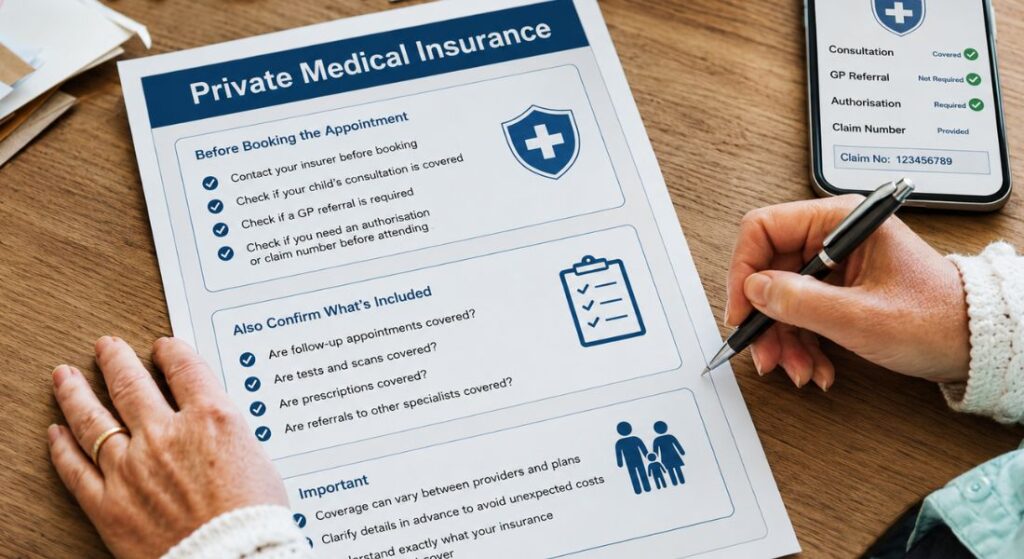
If you plan to use private medical insurance, it is important to contact your insurer before booking the appointment. You should check whether your child’s consultation is covered, whether a GP referral is required, and whether you need an authorisation or claim number before attending.
It is also important to confirm what else may be included in your policy. You should ask whether follow-up appointments, tests, scans, prescriptions, or referrals to other specialists are covered, as these can vary significantly between different insurance providers and plans.
Taking time to clarify these details in advance can help you avoid unexpected costs. It also ensures you understand exactly what your insurance will and will not cover, so you can plan your child’s care with more confidence.
Do You Need a GP Referral? Insurance vs Self-Pay
| Situation | GP Referral Needed? | What to Do |
| Paying privately (self-pay) | No (usually not required) | Book directly with the private paediatrician via self-referral |
| Using private medical insurance | Often yes | Check your insurer’s rules before booking and obtain authorisation if needed |
| Complex or long-standing symptoms | Sometimes | Clinic may request GP letter for full medical background |
| Second opinion privately | No | You can usually book directly without referral |
| NHS pathway | Yes | GP referral required to access NHS paediatric services |
Paying Yourself for the Appointment
If you are paying for the appointment yourself, the process is usually straightforward. Many private paediatric clinics allow you to book directly without needing a GP referral, which can make access to care quicker and more flexible when you are concerned about your child.
This is often referred to as self-pay. You pay the clinic directly for the consultation, and there may be additional costs for services such as tests, follow-up appointments, or prescriptions if they are required. The exact fees can vary depending on the clinic and the type of assessment needed.
Before booking, it is important for you to ask what the consultation fee includes. You should also clarify whether written reports, investigations, prescriptions, or follow-up advice are charged separately. Having this information in advance helps you understand the overall cost and avoid unexpected expenses.
Can You See an NHS Paediatrician Without a GP Referral?
For routine NHS specialist care, you usually need a referral from your GP or another healthcare professional. This is because NHS specialist services are organised through referral pathways.
Your GP will assess whether specialist care is needed and choose the most appropriate route. Depending on the concern, your child may be referred to a hospital paediatrician, community paediatrician, specialist clinic or another service.
There are exceptions in urgent situations. If your child is seriously unwell, you should not wait for a GP referral; you should use urgent NHS services, NHS 111, A&E or 999 depending on the severity of symptoms.
Private Care vs NHS Referral Pathways
Private care and NHS care follow different pathways, and understanding this can help you decide which option is most appropriate for your child. With private care, you may be able to book directly and be seen sooner for non-emergency concerns, which can be helpful when you are seeking quicker reassurance or specialist advice.
With NHS care, your GP usually acts as the first point of contact. They assess your child’s symptoms and decide whether a referral to a paediatrician or another specialist is needed. This structured process helps ensure children are directed to the most appropriate service based on clinical urgency and need.
Both routes have important value. NHS care is essential for urgent situations, emergency treatment, hospital-based services, and many long-term conditions. Private care, on the other hand, can offer faster access, more flexibility with appointment times, and longer consultations for suitable non-emergency concerns, helping you get clearer guidance when you need it.
Evidence Note:
Research on paediatric referrals shows that families often value clear communication, timely follow-up and coordinated care when a child is referred for specialist support. For parents, this means referral route matters, but so does the quality of information shared between professionals. Whether you self-refer privately or go through your GP, bringing previous letters, test results and medication details can help the paediatrician make a more informed assessment.
Does Seeing a Private Paediatrician Replace Your GP?
Seeing a private paediatrician does not replace your GP. Your GP remains an important part of your child’s overall healthcare and continues to play a central role in ongoing medical support.
Your GP can provide routine care, childhood vaccinations, NHS referrals, repeat prescriptions where appropriate, and long-term management of your child’s medical record. They can also coordinate care if your child needs NHS hospital services or community-based support in the future.
A private paediatrician can work alongside your GP by offering specialist assessment, advice, and detailed clinic letters. With your permission, the paediatrician can usually share their findings with your GP so that all healthcare professionals involved in your child’s care remain informed and aligned.
Why Some Parents Choose to Book Directly
Many parents choose to book directly because they want quicker reassurance when their child has ongoing or recurring symptoms. Waiting for answers can feel stressful, especially when you are unsure what is causing the problem or how quickly it may improve.
You may also prefer a longer appointment where you have enough time to explain your child’s full history without feeling rushed. This can be particularly helpful when symptoms are affecting sleep, school, feeding, behaviour, or daily family life, as it allows a more detailed discussion of your concerns.
Some parents also choose private care to obtain a second opinion. This can be useful if you have already received medical advice but still feel uncertain about the diagnosis or treatment plan.
In some cases, you may simply want more flexibility in how and when you access care. Being able to choose an appointment time that suits your family can make the process feel easier and more manageable.
Symptoms That May Lead Parents to Self-Refer
Parents may choose to self-refer to a private paediatrician for a wide range of concerns, particularly when symptoms are ongoing or keep returning rather than being urgent emergencies. This can help you access specialist advice sooner when something does not feel quite right.
Common reasons for self-referral include recurrent coughs, wheezing, repeated infections, tummy pain, constipation, diarrhoea, reflux, feeding difficulties, poor weight gain, allergies, eczema, headaches, sleep problems, and persistent tiredness. Developmental concerns, such as delays in speech, movement, learning, or behaviour, may also prompt parents to seek further assessment.
You do not need to have everything clearly explained before making an appointment. It is enough to describe what you have noticed, how long it has been happening, and what worries you most about your child’s health.
When You Should Not Wait for a Private Appointment
Some symptoms require urgent medical attention and should not wait for a routine private appointment. If your child appears seriously unwell, NHS urgent or emergency care is usually the safest and most appropriate option.
You should seek urgent help if your child has difficulty breathing, blue lips, a seizure, severe drowsiness, a non-blanching rash, signs of dehydration, severe pain, a stiff neck, or any symptoms that make you feel something is seriously wrong. Trust your instincts if you are concerned about your child’s condition.
If symptoms are life-threatening, you should call 999 or go directly to A&E without delay. If you are unsure what to do and the situation is not immediately life-threatening, NHS 111 can provide advice and help you access the right level of care.
UK Safety-Net Note:
In the UK, self-referral to a private paediatrician is not suitable for emergencies. If your child has severe breathing difficulty, blue lips, a seizure, a non-blanching rash, severe drowsiness, signs of dehydration, severe pain, a stiff neck or you feel something is seriously wrong, seek urgent help through 999, A&E or NHS 111 rather than waiting for a routine appointment.
Can a Private Paediatrician Refer Your Child for Tests?

Yes, a private paediatrician can recommend tests if they are clinically appropriate. These may include blood tests, urine tests, stool tests, allergy testing, imaging, or other investigations, depending on your child’s symptoms and medical history.
However, not every child will need tests. In many cases, a detailed history and physical examination are enough for the paediatrician to make an assessment and decide on the next steps without further investigations.
A good paediatrician should explain why a test is being recommended and what information it is expected to provide. You should also feel comfortable asking about the cost, timing, and how the results will be shared with you once they are available.
Can a Private Paediatrician Refer to Another Specialist?
Yes, a private paediatrician can refer your child to another specialist if needed. This may include an allergy specialist, ENT doctor, dermatologist, dietitian, physiotherapist, psychologist, speech and language therapist or another paediatric sub-specialist.
This can be helpful if your child’s symptoms need more focused expertise. For example, a child with suspected food allergy may need allergy input, while a child with persistent snoring may need ENT review.
A private referral may be made within private care, or your GP may be asked to support an NHS referral if that is more appropriate. The best route depends on your child’s needs and your preferences.
Can a Private Paediatrician Refer Back to the NHS?
A private paediatrician may recommend that your child needs NHS care, especially if the concern requires hospital-based services, urgent care, community services or long-term specialist pathways. In many cases, your GP may need to help make the NHS referral.
This is because NHS services often require referrals through established NHS routes. This is another reason why keeping your GP informed can be helpful. Good communication between private and NHS care supports safer, more joined-up care for your child.
What Information Should You Provide When Self-Referring?
When you contact a private clinic, it is important to explain your child’s main symptoms as clearly as possible. You do not need medical language; simple, straightforward details are usually the most helpful for the team to understand your concern.
You should mention your child’s age, the main symptoms, how long they have been present, whether they are getting better or worse, and whether your child has already seen a GP or another healthcare professional. It is also important to include any known allergies, current medications, or long-term health conditions.
If your child is very unwell, you should make this clear when you contact the clinic. In some situations, they may advise you to seek urgent or emergency care instead of booking a routine appointment, to ensure your child receives the most appropriate and timely treatment.
What Should You Bring to the Appointment?
If you self-refer, it is especially helpful to bring any relevant medical information, as this helps the paediatrician understand your child’s history in the same way a referral letter would. Having this information ready can make the consultation more focused and efficient.
You should bring your child’s red book if applicable, along with any previous clinic letters, test results, medication details, allergy information, and hospital discharge summaries. If your child has symptoms such as a rash, swelling, or other issues that come and go, photographs can be particularly useful for the paediatrician to review.
You may also find it helpful to bring a short symptom diary. Recording when symptoms occur, how long they last, possible triggers, and what seems to improve them can provide valuable insight and help the paediatrician form a clearer understanding of your child’s condition.
Should You Tell Your GP Afterwards?
In most cases, it is sensible to keep your GP informed after a private paediatric appointment. Your GP holds your child’s NHS medical record and may need to know about any diagnoses, treatments, prescriptions, or test results that come from the consultation.
With your consent, a private paediatrician will often send a letter to your GP summarising the assessment and plan. This helps ensure continuity of care, avoids unnecessary repetition, and keeps your child’s medical records accurate and up to date.
If you prefer not to share information with your GP, you can discuss this with the clinic. However, in many situations, sharing details between private and NHS care supports safer, more coordinated care for your child and helps all professionals involved stay fully informed.
What Happens If Your Child Needs Medication?

A private paediatrician may recommend medication if it is needed for your child’s condition. This may be issued as a private prescription, which can involve different costs compared with NHS prescriptions, depending on the medicine and pharmacy used.
The paediatrician should clearly explain what the medication is for, how and when to give it, how long it should be continued, and any possible side effects to watch for. You should also be told what to do if your child’s symptoms do not improve or if they get worse while taking the medicine.
If longer-term treatment is required, the paediatrician may suggest involving your GP for ongoing prescribing and monitoring. This will depend on the type of medication, your child’s diagnosis, and whether shared care with the NHS is appropriate for continued management.
What If You Are Unsure Whether to Self-Refer?
If you are not sure whether to book directly, you can contact the private clinic and ask. Many clinics can advise whether your child’s concern sounds suitable for a routine paediatric appointment.
You can also speak to your GP first if you prefer. This may be useful if your child has complex symptoms, previous medical problems or you are unsure whether the issue needs urgent care.
You do not have to make the decision perfectly. The important thing is to choose a safe route based on how unwell your child is and how quickly they need help.
Is Self-Referral Safe?
Self-referral can be safe when it is used appropriately for non-emergency concerns. A private paediatrician is trained to assess children, identify potential causes of symptoms, and recommend the most suitable next steps for your child’s care.
However, self-referral should never be used as a substitute for urgent or emergency medical attention. If your child is very unwell, having difficulty breathing, unusually drowsy, dehydrated, in severe pain, or showing any worrying symptoms, you should seek urgent help immediately rather than waiting for a private appointment.
It is also important to ensure that you choose a properly qualified doctor. You should check that the paediatrician is registered with the General Medical Council and has appropriate specialist training and experience in paediatrics, so you can feel confident that your child is receiving safe and appropriate care.
Myth vs Fact
| Myth | Fact |
| Self-referral means skipping proper medical care. | A private paediatrician should still take a full history, examine your child when needed and create a clinical plan. |
| You always need a GP referral before seeing a paediatrician. | For self-pay private care, many clinics allow direct booking without a GP referral. |
| Self-referral is suitable for emergencies. | Serious symptoms should go through NHS urgent care, A&E or 999. |
| Private care replaces your GP. | Your GP remains important for NHS records, routine care, prescriptions and referrals. |
| Insurance always covers direct booking. | Many insurers require a GP referral or authorisation before they cover the appointment. |
How to Choose a Private Paediatrician

When choosing a private paediatrician, it is important to consider their qualifications, experience, clinic standards, communication style, and appointment availability. You want a doctor who understands children’s health in depth and makes you feel listened to and supported throughout the consultation.
It can also be helpful to check whether the paediatrician is a consultant and whether the clinic provides clear written summaries after appointments. Good follow-up arrangements are especially important if your child may need tests, ongoing monitoring, or further review after the initial visit.
Practical factors should not be overlooked. You should think about the clinic’s location, appointment times, fees, insurance coverage, and how easily follow-up appointments can be arranged if your child needs further care. These details can make a significant difference to your overall experience.
UK Clinical Note:
Before booking, you can check whether a doctor is registered with the General Medical Council. If you are looking for consultant-level paediatric care, it is also helpful to check whether the doctor appears on the GMC Specialist Register. This can give you reassurance that the doctor has recognised specialist training and is eligible for consultant-level roles.
Booking a Paediatrician in London Without a GP Referral
In London, many private paediatric clinics allow you to book directly without needing a GP referral. This can be useful if you want quicker access to specialist advice and prefer not to wait for the NHS referral pathway to progress.
You may choose this option if your child has symptoms such as feeding problems, allergies, recurrent cough, constipation, tummy pain, growth concerns, developmental worries, headaches, or ongoing tiredness. The aim of the appointment is to help you understand what may be happening and what the most appropriate next steps are for your child.
If you are considering booking a paediatrician in London without a GP referral, it is worth checking how the clinic works before you arrange the appointment. You should look at consultant experience, consultation fees, booking process, and how follow-up care is managed so you feel confident in your decision.
Benefits of Seeing a Paediatrician Without a GP Referral
One of the main benefits of seeing a paediatrician without a GP referral is quicker access to specialist advice. If your child has symptoms that are concerning but not urgent, you may be able to arrange a private appointment sooner, which can help reduce anxiety and provide earlier clarity.
Another benefit is flexibility and convenience. You can often choose the clinic, consultant, and appointment time that best suits your family’s schedule. This can make it easier to fit medical care around school, work, and other commitments without long waiting times.
You may also benefit from a longer consultation. More time allows you to explain your child’s symptoms in detail, ask questions, and discuss concerns fully. This can help you leave the appointment with a clearer understanding of your child’s condition and a more structured plan for the next steps.
Limitations of Seeing a Paediatrician Without a GP Referral
The main limitation of seeing a paediatrician without a GP referral is that the doctor may not automatically have access to your child’s full medical history. This is why it is important for you to bring any previous clinic letters, test results, medication details, and relevant medical documents to the appointment. A complete history helps the paediatrician make a more accurate assessment.
Another limitation to consider is cost. If you are self-funding the appointment, it is important for you to understand the consultation fees in advance, as well as any additional charges for tests, follow-up visits, or prescriptions. This helps you avoid unexpected expenses and plan accordingly.
In some situations, private care may not replace NHS pathways. If your child needs hospital-based treatment or ongoing community services, your GP may still need to be involved in the referral process. Understanding how both systems work together helps you choose the most appropriate route for your child’s care.
Private and NHS Care Can Work Together
You do not have to think of private and NHS care as completely separate systems. Many families use both at different times, depending on their child’s needs and the urgency of the situation. This combined approach can often provide flexibility while still ensuring continuity of care.
For example, you may choose to see a private paediatrician for a quicker assessment of a non-emergency concern, while continuing to use your GP for routine care and NHS services for urgent or long-term medical support. When communication is clear between all parties, this approach can work effectively and support your child’s overall care.
The key is ensuring that important information is shared across both pathways. Keeping copies of clinic letters, test results, and care plans can help prevent misunderstandings and ensure that any doctor involved in your child’s care has a complete picture of their health.
Key Takeaways
- You can often book a private paediatrician directly without a GP referral if you are paying yourself.
- This is called self-referral and is usually suitable for non-emergency concerns.
- Private medical insurance may still require a GP referral or authorisation before the appointment is covered.
- A GP referral can be useful if your child has complex symptoms, previous test results or a long medical history.
- Private paediatric care does not replace your GP or NHS urgent care.
- Bring previous letters, test results, medication details, allergy information and a symptom diary if you self-refer.
- Seek urgent NHS help if your child appears seriously unwell or has red-flag symptoms.
FAQs:
1. Do you need a GP referral to see a private paediatrician?
No, in most cases you do not need a GP referral to see a private paediatrician if you are paying for the consultation yourself. Many private clinics allow parents to book directly through self-referral. The paediatrician will still carry out a full medical assessment during the appointment, including history, examination and advice.
2. What is self-referral for a paediatrician?
Self-referral means you can contact a private paediatric clinic directly without seeing your GP first. You simply explain your child’s symptoms and book an appointment. This gives quicker access to specialist care, while still ensuring your child receives a proper clinical assessment once seen by the paediatrician.
3. When might a GP referral still be required?
A GP referral may be required if you are using private medical insurance, as many insurers need a referral letter or authorisation before covering the consultation. In some cases, clinics may also request a GP letter to better understand your child’s medical background, especially if symptoms are complex or long-standing.
4. Is it better to see a GP before a paediatrician?
It depends on the situation. A GP is often a good first step for general assessment and NHS referral pathways. However, if you want quicker access, a longer consultation, or specialist reassurance for ongoing symptoms, booking directly with a private paediatrician can be more convenient. Both routes can work together depending on your child’s needs.
5. Can private medical insurance be used without a GP referral?
This depends entirely on your insurance provider. Some insurers require a GP referral or approval code before they cover the appointment, while others allow direct access to a paediatrician. It is always best to check your policy in advance so you understand what is covered and avoid unexpected costs.
6. What information should be provided when booking directly?
When self-referring, you should give clear details about your child’s condition. This includes age, main symptoms, when they started, how often they occur, and whether they are getting worse. It is also helpful to mention any previous GP visits, medications, allergies, and any other medical concerns so the clinic can prepare for the consultation.
7. Will the paediatrician inform my GP after the appointment?
In most cases, yes, especially if you give permission. The paediatrician usually sends a written clinic letter or summary to your GP explaining the findings, diagnosis (if any), tests, and treatment plan. This ensures your child’s medical records stay complete and helps maintain continuity of care between private and NHS services.
8. Can a private paediatrician arrange tests without a GP?
Yes, a private paediatrician can directly arrange tests if they are clinically needed. This may include blood tests, urine tests, stool tests, allergy testing, breathing tests, or imaging scans. However, tests are only recommended when necessary, and the doctor should clearly explain why the test is useful and what the results may show.
9. Can a private paediatrician refer my child to the NHS?
Yes, a private paediatrician can advise or recommend NHS referral if your child needs hospital-based care, long-term specialist follow-up, or services not suitable for private management. In many cases, your GP may still need to complete the NHS referral process, but the paediatrician will provide detailed clinical guidance and supporting letters.
10. When should self-referral be avoided in favour of urgent care?
Self-referral is not suitable for emergencies. You should seek urgent medical help immediately if your child has difficulty breathing, blue lips, seizures, severe drowsiness, signs of dehydration, a non-blanching rash, severe or worsening pain, or any symptom that makes you feel your child is seriously unwell. In these cases, call 999 or go to A&E without delay.
Final Thoughts: Understanding Your Options for Paediatric Care Without a GP Referral
Knowing whether you need a GP referral to see a paediatrician can help you make quicker, more confident decisions when your child is unwell or you are worried about their health. In many cases, especially when choosing private care, you can book directly through self-referral without needing to wait for a GP appointment. This allows faster access to specialist advice, reassurance, and a clear care plan tailored to your child’s needs.
However, GP referrals can still be helpful, particularly if your child has a complex medical history, you are using private medical insurance, or further coordination with NHS services is required. Both pathways can work together to ensure your child receives the right level of care at the right time.
If your child needs support from a specialist paediatrician in London, you can contact London Paediatric Clinic for guidance and assessment. Our aim is to provide clear, compassionate, and timely care so you can feel reassured about your child’s health and next steps.
References:
- Mwanga-Amumpaire, J., Kalyango, J.N., Ndeezi, G., Rujumba, J., Owokuhaisa, J., Stålsby Lundborg, C., Alfvén, T., Obua, C. and Källander, K. (2021) A qualitative exploration of the referral process of children with common infections from private low-level health facilities in Western Uganda, Children, 8(11), p.996. Available at: https://www.mdpi.com/2227-9067/8/11/996
- Freed, G.L., Turbitt, E., Kunin, M., Gafforini, S., Sanci, L. and Spike, N. (2017) Children referred for specialty care: Parental perspectives and preferences on referral, follow-up and primary care, Journal of Paediatrics and Child Health, 53(1), pp.18–25. Available at: https://pubmed.ncbi.nlm.nih.gov/27696573/
- Ray, K.N., Ashcraft, L.E., Kahn, J.M., Mehrotra, A. and Miller, E. (2016) Family perspectives on high-quality pediatric subspecialty referrals, Academic Pediatrics, 16(6), pp.594–600. Available at: https://pmc.ncbi.nlm.nih.gov/articles/PMC4975949/
- Zuckerman, K.E., Cai, X., Perrin, J.M. and Donelan, K. (2011) Incomplete specialty referral among children in community health centers, The Journal of Pediatrics, 158(1), pp.24–30. Available at: https://www.sciencedirect.com/science/article/abs/pii/S0022347610005901
- Cameron, E., Heath, G., Redwood, S., Greenfield, S., Cummins, C., Kelly, D. and Pattison, H. (2014) Health care professionals views of paediatric outpatient non-attendance: implications for general practice, Family Practice, 31(1), pp.111–117. Available at: https://academic.oup.com/fampra/article/31/1/111/438165