



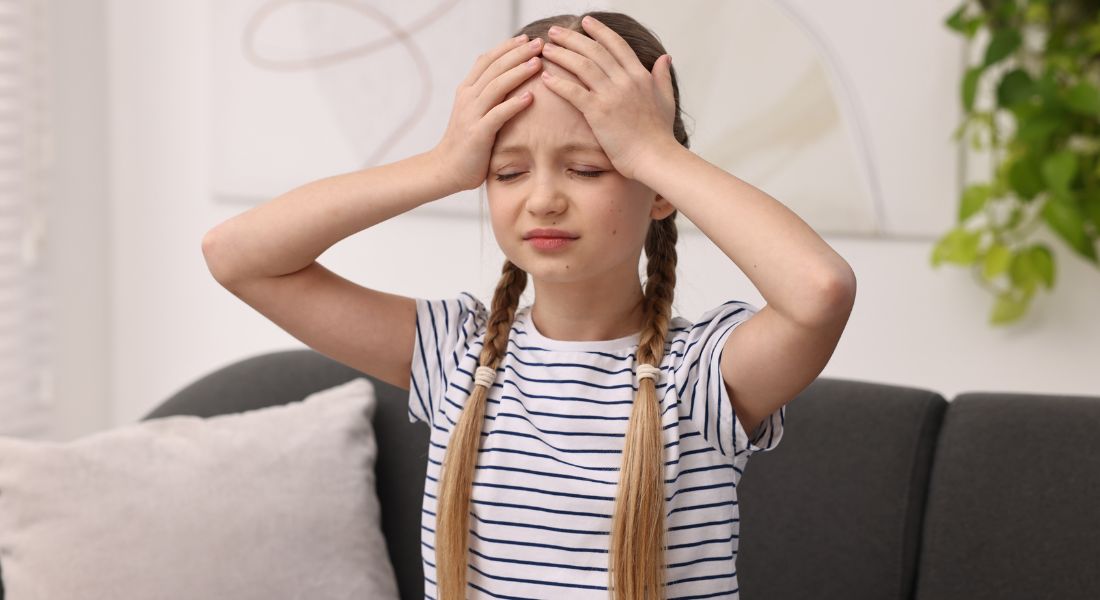
When your child complains of pain around the forehead, cheeks, eyes or bridge of the nose, you may naturally assume that their sinuses are responsible. Parents often use the term ‘sinus headache’ when pain seems to come from the face rather than the whole head.
However, the location of the pain does not always show the true cause. You may notice that your child has facial pressure or forehead pain with sinusitis, but these symptoms can also occur with migraine, tension-type headache and other causes of facial pain.
This can make it difficult for you to know what is really happening, especially when symptoms overlap. A child with migraine may have pain around the eyes or forehead, while a child with sinus inflammation may have similar discomfort alongside nasal symptoms.
That is why recurring headaches need careful assessment. You and your clinician need to look at the complete pattern, including nasal symptoms, headache features and how the symptoms change over time, to decide whether the sinuses are truly involved or whether another condition needs a different treatment approach.
What Do People Mean by a Sinus Headache?
The phrase “sinus headache” is commonly used to describe pain or pressure around the forehead, cheeks, eyes or nose. You may assume that pain in these areas means your child’s sinuses are responsible, but this is not always the case.
A sinus-related headache cannot be diagnosed based on pain location alone. Your doctor will look for clinical evidence of rhinosinusitis and consider whether there is a convincing relationship between the sinus condition and the headache, such as both starting together or the headache improving as the sinus inflammation resolves.
Pain around the sinuses does not automatically mean the sinuses are causing the headache. By looking at the full pattern of symptoms, you and your clinician can better understand whether the cause is sinus-related or whether another headache disorder may be involved.
What Are the Sinuses?
The sinuses are air-filled spaces that connect with the nasal passages. When the lining of the nose and sinuses becomes inflamed, you may notice that your child develops symptoms such as congestion, nasal discharge, facial pressure and sometimes a headache.
Doctors may use the term rhinosinusitis because the inflammation usually affects both the nasal passages and the sinus spaces. Sinusitis commonly develops after a cold or flu-like illness and often causes symptoms that overlap with other common childhood infections.
It is important to remember that your child can have nasal symptoms without a significant headache, and they can also have pain around the face without genuine sinusitis. This is why you and your doctor need to look at the wider pattern of symptoms rather than relying on one symptom alone.
What Is Sinusitis?
Sinusitis is inflammation of the lining of the sinuses. You may notice symptoms such as pain or tenderness around your child’s cheeks, eyes or forehead, along with a blocked or runny nose, a reduced sense of smell or coloured nasal discharge. Headache, cough, toothache, bad breath and fever can also occur.
In children, the symptoms are often less specific than they are in adults. You may find that younger children develop symptoms that overlap with many other common infections, making it difficult to tell whether the problem is truly related to the sinuses.
This overlap is one reason to avoid assuming that every prolonged cold or facial headache is a bacterial sinus infection. Looking at the overall pattern of symptoms can help you and your doctor decide what is most likely to be causing your child’s illness.
Why Forehead Pain Does Not Automatically Mean Sinus Disease
Pain in the forehead does not automatically mean that your child has a sinus problem. You may associate forehead pain with the sinuses, but this area is also commonly affected by migraine and tension-type headaches. Migraine can cause pain around the forehead, temples or eyes, while tension-type headache often creates a feeling of pressure across the forehead or both sides of the head.
You should also remember that facial pain can have many different causes. Problems involving muscles, joints, teeth, facial nerves and other headache disorders can all cause pain in a similar area, and only some cases are genuinely related to the sinuses.
This is why doctors do not rely on the location of the pain alone. You may find that your doctor also asks about nasal symptoms, the timing of the illness, the characteristics of the headache, associated symptoms and examination findings before deciding on the most likely diagnosis.
Why “Sinus Headache” Can Be Confused With Migraine
Migraine can cause pain around the forehead, eyes or face, which is one reason why it is often confused with a sinus headache. You may also notice that your child develops nasal or eye symptoms during a migraine attack, making it even harder to tell the difference.
Research has shown that many children referred with a presumed “sinus headache” are actually found to have a primary headache disorder, particularly migraine. You may therefore find that the location of the pain does not always point to the correct diagnosis.
This does not mean that sinus-related headaches never occur. However, you should not assume that repeated headaches are caused by sinus disease without looking at the wider pattern of symptoms and considering whether migraine or another headache disorder may be a better explanation.
Research Insight: Why Accurate Diagnosis Matters
Research involving children and adolescents with recurrent or chronic headaches has shown that primary headache disorders can sometimes be mistaken for sinus-related pain. In one study, around 40% of children with migraine and 60% of those with tension-type headache had previously been misdiagnosed as having a sinus headache. These figures come from one study and should not be treated as predictions for an individual child, but they highlight why repeated ‘sinus headaches’ deserve a full headache assessment rather than repeated treatment based only on the location of the pain.
For you as a parent, the practical message is simple: if your child’s headaches keep returning, continue after the nasal illness settles or include features such as nausea and sensitivity to light or sound, it is worth asking whether a primary headache disorder should also be considered.
Symptoms That Make Sinusitis More Likely
A headache is more likely to be related to sinusitis when it occurs alongside clear nasal and upper respiratory symptoms. You may notice significant nasal blockage, nasal discharge, facial pressure or tenderness, a reduced sense of smell, fever or symptoms that develop after a cold.
The pattern of symptoms is also important. You may find that your child’s headache appears at the same time as the nasal symptoms and changes as the illness progresses.
The relationship over time can provide useful clues. If your child’s headache improves as the sinus inflammation settles, you may have stronger evidence that the headache is genuinely linked to the sinus condition.
Symptoms That May Point More Towards Migraine
Some symptoms may suggest that your child’s headaches are more likely to be migraine than a sinus problem. You may notice moderate or severe headaches accompanied by nausea, vomiting or sensitivity to light and sound. During an attack, your child may stop normal activities and want to rest in a quiet or dark room.
Migraine in children does not always look the same as it does in adults. You may be surprised to learn that childhood migraine attacks can be shorter and may affect both sides of the head rather than just one side.
If your child has repeated episodes of headache with light sensitivity, nausea and periods of feeling completely well between attacks, you should consider the possibility of migraine. This can still be the case even if your child feels the pain around the forehead or eyes.
Sinusitis, Migraine and Tension-Type Headache Compared
The table below shows some common differences. It is intended as a guide rather than a way to diagnose your child at home.
| Feature | Sinusitis-Related Headache | Migraine | Tension-Type Headache |
| Nasal symptoms | Usually prominent when sinusitis is active | May be absent or less central to the pattern | Usually not a defining feature |
| Nasal discharge | May be present | Not usually a central diagnostic feature | Not usually related |
| Fever or recent infection | May occur | Usually not part of a typical migraine attack | Usually absent |
| Nausea or vomiting | Can occur with illness but is not the classic defining pattern | Common in some attacks | Usually absent |
| Light or sound sensitivity | Less characteristic | Common migraine features | Usually less prominent |
| Pain quality | Facial pain or pressure may accompany sinus symptoms | May be throbbing or severe | Often pressing or tightening |
| Pattern | Often follows the sinus illness pattern | Recurrent attacks with recovery between episodes | May relate to stress, fatigue or routine |
| Activity | Depends on illness severity | Activity may worsen symptoms | Ordinary activity may be tolerated |
No single feature proves the diagnosis. The most useful approach is to look at the complete pattern of symptoms and how they change over time.
What Is Acute Sinusitis?
Acute sinusitis is a short-term episode of inflammation affecting the nose and sinuses. For uncomplicated acute sinusitis, NICE advises that the usual course is around two to three weeks. Many children improve without antibiotics, although the treatment and urgency of assessment depend on symptom severity, duration and whether any complications are suspected.
It often develops after a viral upper respiratory infection, such as a common cold. You may find that the symptoms overlap considerably with an ordinary cold, which can make it difficult to tell the difference, particularly in younger children.
The presence of coloured nasal mucus and a headache does not automatically mean that your child needs antibiotics. Your doctor will consider how long the symptoms have been present, how severe they are and the overall pattern of the illness before deciding on the most appropriate treatment.
UK Guidance Note
NICE advises that acute sinusitis usually lasts around two to three weeks and that antibiotics are not routinely needed when symptoms have been present for around 10 days or less. If symptoms continue for longer without improvement, become significantly worse or your child becomes very unwell, the situation should be reassessed.
Doctors do not use mucus colour alone to decide whether a bacterial infection is likely. They consider the whole pattern, including duration, fever, severe localised pain and whether symptoms became noticeably worse after initially being milder.
What Is Chronic Sinusitis?
Chronic sinusitis refers to persistent inflammation of the nose and sinuses that lasts for 12 weeks or longer. You may notice that your child has ongoing nasal blockage, discharge or other symptoms that do not seem to settle in the way that a typical cold would.
A child with long-standing nasal symptoms usually needs a broader assessment than a child who has developed symptoms after a short viral illness. You may find that your doctor wants to explore other factors that could be contributing to the problem and consider whether further investigation is needed.
It is also important to remember that chronic headaches alongside long-term nasal symptoms still require careful evaluation. You should not assume that every headache is caused by sinus abnormalities, as your child may have another headache disorder occurring at the same time.
Can a Cold Lead to Sinus Pain?
Yes. A cold or flu can sometimes lead to sinus inflammation, which may cause pressure, tenderness and discomfort around your child’s face. You may notice that your child develops a headache or complains of facial pain while they are unwell.
However, you should not assume that every cold with a headache means your child has developed sinusitis. Many children experience temporary headaches during viral illnesses, and these symptoms often improve as the infection settles.
It is helpful to look at how the illness progresses. If your child’s symptoms become severe, start worsening, last longer than expected or are accompanied by other concerning features, you should arrange a medical assessment.
Does Green or Yellow Mucus Prove a Bacterial Sinus Infection?
No. Green or yellow mucus does not automatically mean your child has a bacterial sinus infection. The colour of the mucus on its own cannot confirm the cause of the illness.
When assessing acute sinusitis, doctors look at the overall clinical picture, including how long the symptoms have been present and how severe they are. You may find that the pattern of symptoms is more important than any single sign.
This matters because unnecessary antibiotics will not treat migraine, tension-type headache or other non-bacterial causes of facial pain. You may also be reassured to know that many cases of uncomplicated acute sinusitis improve without an antibiotic prescription.
Can Bending Forward Make Sinus Pain Worse?
Some children and adults notice that facial pressure feels worse when they bend forward or change position. You may find that your child complains of increased discomfort when leaning over, but this symptom alone does not confirm that the pain is coming from the sinuses.
Headache disorders often have overlapping features, so you should avoid relying on a single symptom when trying to understand the cause. The location of the pain or the effect of a particular movement is only one part of the overall picture.
To diagnose a true sinus-related headache, doctors look for evidence of rhinosinusitis together with a convincing link between the sinus condition and the headache. You may therefore find that a child who has pain that worsens on bending forward is ultimately diagnosed with a different type of headache altogether.
How Sinus Symptoms Can Look in Younger Children
Young children may not tell you that they have facial pressure or a sinus headache. Instead, you may notice that your child has become irritable, is sleeping poorly, eating less or simply seems uncomfortable and out of sorts.
You may also see your child breathing through their mouth because of nasal blockage or struggling to explain exactly where the pain is. At this age, children often find it difficult to describe their symptoms clearly.
This is why your observations are so important. You should tell the doctor about any nasal blockage, discharge, fever, cough, sleep changes and how long the symptoms have been present, as these details can help build a clearer picture of what may be causing your child’s symptoms.
Allergic Rhinitis Can Also Cause Nasal Symptoms
Not every blocked or runny nose is caused by a sinus infection. You may notice that your child has sneezing, nasal blockage, itching or a runny nose, but these symptoms can also occur with allergic rhinitis.
If your child has seasonal symptoms, itchy eyes or a clear link with pollen or another trigger, you may need to consider an allergy assessment rather than repeated treatment for suspected sinus infections. You may find that identifying and managing the allergy leads to better symptom control.
Allergy can also be one of several factors contributing to recurrent nasal and sinus problems. This is why your doctor will often look at the bigger picture and consider whether allergies may be playing a role in your child’s symptoms.
Can Allergies Directly Cause a “Sinus Headache”?
Allergies can contribute to nasal inflammation and congestion, but you should not assume that every headache in a child with allergies is a true sinus headache. Although allergy can affect the nose and sinuses, the cause of the headache may be more complicated.
Your child may have allergic rhinitis and migraine at the same time. You may be tempted to blame every headache on nasal congestion because an allergy is present, but this can lead to the real cause being overlooked.
Your doctor will look carefully at the pattern of symptoms. You may be asked whether the headaches occur alongside the nasal symptoms or whether they seem to follow an independent, migraine-like pattern. This broader assessment can help identify the most likely diagnosis and guide the right treatment plan.
Why Repeated Antibiotics May Not Help a Misdiagnosed Headache
When a primary headache disorder is mistaken for a recurrent sinus infection, the treatment may not address the real cause of the symptoms. You may find that your child continues to have headaches even after several courses of antibiotics because the underlying problem has not been identified correctly.
For example, if your child’s actual pattern is migraine, the headaches may keep returning despite treatment for sinusitis. You may become frustrated that the symptoms are not improving, but migraine requires a very different management approach.
This is one reason why an accurate diagnosis matters so much. If your child’s “sinus headaches” keep coming back despite repeated sinus treatments, you should consider whether the diagnosis needs to be reviewed rather than simply repeating the same treatment again.
How Doctors Assess a Possible Sinus Headache

The assessment usually begins with a detailed history. Your doctor will want to know when your child’s headaches started, where the pain occurs, how long it lasts and whether it tends to follow colds or other nasal symptoms.
You may be asked about nasal blockage, discharge, fever, changes in the sense of smell, cough and facial tenderness. Your doctor may also ask about symptoms such as nausea, vomiting, sensitivity to light or sound and whether there is a family history of migraine.
The aim is to understand whether your child’s headaches follow a pattern that suggests a sinus illness or whether they look more like a primary headache disorder. By looking at the whole picture, your clinician can decide which diagnosis is most likely and what the next steps should be.
The Physical Examination
The doctor will examine your child according to their symptoms and medical history. You may find that the assessment includes looking at your child’s general condition, examining the nose and face, and checking for any relevant neurological signs.
The aim is not simply to press on the forehead and decide whether the sinuses are causing the pain. You should be aware that facial tenderness on its own is not enough to make a complete diagnosis, and your doctor will consider the wider pattern of symptoms.
If the history suggests a primary headache disorder, your child may also need a broader headache and neurological assessment. This more detailed approach can help you and your clinician better understand what is causing the symptoms and guide the most appropriate treatment plan.
Does Every Child Need a Sinus Scan?
No. You should not assume that your child automatically needs a scan simply because they have facial pain, headaches or an uncomplicated episode of suspected sinusitis. In many cases, you may find that imaging is unnecessary and does not change the initial management plan.
Whether a scan is needed depends on your child’s individual situation. You may be advised to consider imaging if complications are suspected, if the symptoms are persistent, if the diagnosis remains uncertain or if specialist treatment planning requires further investigation.
If your child has repeated headaches without convincing evidence of sinus disease, you may find that a detailed headache assessment is more helpful than sinus imaging. Looking at your child’s overall pattern of symptoms often provides more useful information than a scan alone and can help guide the most appropriate next steps.
Can a Scan Show Sinus Changes That Are Not Causing the Headache?
Yes. A scan can sometimes show sinus changes that are not actually causing your child’s headache. You should remember that scan findings always need to be interpreted alongside your child’s symptoms and clinical history.
A diagnosis of sinus-related headache is not based on imaging alone. Doctors also look for evidence that the headache and the sinus condition are genuinely linked and that the two follow a similar pattern over time.
This is important because it helps prevent every headache from being automatically blamed on a sinus finding that may not explain the real problem. You may find that a child has changes on a scan but is actually experiencing migraine, tension-type headache or another headache disorder.
Evidence Note: A Scan Does Not Diagnose the Cause on Its Own
International headache classification criteria do not diagnose sinus-related headache from a scan finding alone. Doctors look for evidence that the headache developed in relation to rhinosinusitis and that the headache pattern changes alongside the sinus condition.
This means that an abnormal sinus scan and a headache can occur at the same time without necessarily proving that one is causing the other. Your child’s symptoms, examination and the way the headache changes over time remain important parts of the assessment.
Why a Headache Diary Can Be Helpful
When the diagnosis is uncertain, a headache diary can help you see whether your child’s headaches follow a nasal illness or occur independently. You may begin to notice patterns that are difficult to remember when looking back over several weeks or months.
You can record the date, duration and location of each headache. It is also helpful if you note nasal symptoms, fever, illness, nausea, vomiting, sensitivity to light or sound and any medicines your child has taken.
A symptom diary can make it easier for you and your clinician to identify possible triggers and patterns. You may find that keeping these notes provides valuable clues and helps guide a more accurate diagnosis and treatment plan.
What to Record When Sinus Headache Is Suspected
A clear diary can make the distinction between sinus-related symptoms and recurrent headache easier to assess.
| What to Record | Why It Helps |
| Headache date and time | Shows frequency and recurrence |
| Headache duration | Helps identify the overall pattern |
| Pain location | Shows whether the site changes between attacks |
| Nasal blockage | Helps identify a relationship with sinus symptoms |
| Nasal discharge | Shows whether headache occurs with active nasal illness |
| Fever or recent cold | Helps identify an infectious pattern |
| Nausea or vomiting | May support consideration of migraine or illness severity |
| Light and sound sensitivity | Important when migraine is being considered |
| Effect on activity | Shows how disabling the headache is |
| Treatment taken | Helps assess whether previous management has worked |
| Recovery pattern | Shows whether headache improves with the nasal illness |
Do not try to diagnose the cause from the diary alone. Take the information to the GP, paediatrician or specialist so it can be interpreted alongside the examination.
How Acute Sinusitis Is Usually Managed
How acute sinusitis is managed depends on the severity and duration of your child’s symptoms and whether any complications are suspected. You may find that the treatment plan is different depending on how unwell your child is and how long the symptoms have been present.
In many cases, uncomplicated acute sinusitis improves within two to three weeks without specific treatment. You may be reassured to know that many children recover with time and do not need extensive medical intervention.
Supportive care and symptom management are often appropriate for many cases. Your child’s treatment plan should be tailored to their age, medical history and clinical assessment, so you should follow the advice given by your healthcare professional.
Are Antibiotics Always Needed?
No. Antibiotics are not automatically needed for every episode of sinusitis. You may assume that nasal discharge and headache always require antibiotics, but treatment decisions are usually based on the pattern, severity and duration of your child’s symptoms.
Your doctor will consider the wider clinical picture before deciding whether antibiotics are appropriate. You may find that many episodes improve without antibiotics, particularly when the symptoms are mild or caused by a viral infection.
It is also important to remember that antibiotics will not treat migraine, tension-type headache or other non-bacterial causes of facial pain. This is why you and your clinician need an accurate diagnosis before repeated courses of antibiotics are used.
Pain Relief and Symptom Support

Age-appropriate pain relief may sometimes be recommended to help manage your child’s discomfort, depending on their age and medical history. You may find that simple measures and appropriate pain relief help your child feel more comfortable while the underlying illness settles.
You should always follow the advice given by your doctor, pharmacist or the medicine information leaflet. You should not increase doses or combine medicines unless you have checked that the approach is suitable for your child.
If your child repeatedly needs pain relief because the headaches keep returning, you should arrange a medical review rather than continuing self-treatment indefinitely. Looking at the overall headache pattern can help you and your clinician decide whether a different diagnosis or management plan needs to be considered.
Nasal Treatments and Saline Measures
Depending on your child’s age and diagnosis, a healthcare professional may suggest simple measures such as nasal saline. Evidence for symptom relief is limited, so it is best to ask a doctor or pharmacist which options are appropriate for your child.
The NHS advises that pharmacists can provide guidance on treatments for sinusitis symptoms, and some nasal treatments may be appropriate depending on your child’s age and the underlying cause of the symptoms. You may find that relatively simple measures are enough to help your child feel more comfortable.
You should not use adult nasal products automatically in a child. Before starting any treatment, you should ask a pharmacist or doctor which products are suitable for your child’s age and how long they should be used safely.
What Happens When Allergy Is Contributing?
When allergic rhinitis is contributing to your child’s symptoms, the treatment plan may focus more on managing the allergy than on prescribing antibiotics. You may find that treating the underlying allergy improves both the nasal symptoms and the associated discomfort.
Your doctor may ask about seasonal patterns, itching, sneezing, watery eyes and possible triggers or exposure patterns. You may also be advised to consider allergy testing in selected situations if the results are likely to influence your child’s treatment plan.
The important point is to treat the condition that is actually present. Your child may have allergy, sinusitis, migraine or even a combination of these conditions, but they are not interchangeable diagnoses. A careful assessment can help you understand which factors are contributing to your child’s symptoms and guide the most appropriate treatment.
Recurrent Sinus Symptoms Need a Wider Review
Repeated episodes of suspected sinusitis may need a broader review rather than repeated courses of treatment without further investigation. If your child keeps developing similar symptoms, you may need to look beyond the idea of another simple sinus infection.
During the assessment, your clinician may consider allergies, recurrent infections and other factors that could be contributing to the repeated nasal symptoms. You may also be asked about symptom patterns, possible triggers and whether anyone else in the family has similar problems.
The review should also reconsider the headache diagnosis. Your child may have genuine nasal symptoms but also have a separate migraine or tension-type headache disorder. Looking at the bigger picture can help you and your clinician find the most appropriate explanation and treatment plan.
Persistent Headaches After Sinus Symptoms Improve
A headache that continues after your child’s nasal symptoms have improved deserves further assessment. You may assume that the headache is still related to the previous sinus infection, but this is not always the case.
When headaches are linked to acute rhinosinusitis, they often improve as the underlying sinus symptoms resolve. If you notice that your child’s nose is better but the same recurrent headache continues, you should consider that another cause may be responsible.
In this situation, migraine, tension-type headache or another diagnosis may need to be considered. You may find that a reassessment helps clarify the pattern and leads to a more appropriate treatment plan for your child.
When Sinusitis Can Become Serious
Serious complications of sinusitis are rare, but you should know that they can affect the tissues around the eye, the bones or even structures inside the skull. Although these complications are uncommon, you should be aware that sinus infections can occasionally become much more serious.
This is why you should not treat severe or rapidly worsening symptoms as an ordinary headache at home. If you notice that your child seems significantly more unwell or the symptoms are changing quickly, you should seek medical advice promptly.
A child who is seriously unwell, develops significant swelling around the eye, shows neurological symptoms or has signs that could suggest meningitis needs urgent medical assessment. If you notice any of these warning signs, you should seek emergency care rather than waiting to see whether the symptoms improve.
Warning Signs Around the Eyes
Sinus infections can rarely lead to complications involving the tissues around the eye. You should pay close attention if your child develops increasing swelling, redness or significant pain around one or both eyes during a sinus illness.
You should also seek urgent medical advice if your child has difficulty moving the eye, complains of double vision or develops any change in vision. These symptoms can occasionally indicate a more serious complication affecting the tissues around the eye.
Do not wait for a routine headache appointment if significant eye symptoms are developing alongside a sinus infection. If you notice these warning signs, your child should be assessed urgently.
Neurological Warning Signs
Severe frontal headache accompanied by focal neurological symptoms or signs of meningitis requires urgent medical assessment. You should also be concerned if your child develops symptoms such as weakness, confusion, difficulty speaking or problems with balance alongside the headache.
Other warning signs include altered consciousness or a child who becomes unusually drowsy or difficult to wake. You may notice that your child seems confused, less responsive or generally much more unwell than expected.
If your child appears seriously unwell or develops rapidly worsening neurological symptoms, you should seek emergency medical care straight away. It is far safer to have these symptoms assessed urgently than to assume that the pain is simply caused by sinus pressure.
When to See a GP
Arrange a GP review if your child’s sinus symptoms are persistent, worsening or keep coming back. You should also seek medical advice if the headaches continue after the nasal symptoms have improved or if your child is repeatedly being treated for suspected sinus problems without lasting improvement.
It can be helpful if you bring a brief symptom diary to the appointment. You may notice that writing down when the headaches occur and how they relate to colds or nasal symptoms makes the pattern much clearer.
These details can help your GP understand what may be causing the headaches and decide whether further assessment or a different approach to treatment is needed. You may also find that a written record helps you answer questions more accurately and makes it easier to explain how your child’s symptoms have changed over time.
When to See a Paediatrician
A paediatric review may be helpful if your child’s diagnosis remains uncertain, the headaches keep returning or the symptoms are affecting school, sleep, exercise or normal family life. You may also want specialist advice if the headaches are becoming more frequent or difficult to manage.
A paediatrician can look at the complete pattern of symptoms rather than focusing only on where the pain is located. During the assessment, you and your child may be asked about migraine symptoms, tension-type headaches, sinus problems, allergies and other possible causes.
This broader approach can help you gain a clearer understanding of what may be causing the headaches and guide the most appropriate treatment plan for your child.
When an ENT Specialist May Be Involved
An ear, nose and throat (ENT) specialist may become involved if your child has persistent or recurrent nasal and sinus problems that need further evaluation. You may be referred if your child has long-lasting nasal blockage, repeated significant sinus symptoms or ongoing concerns that require a more detailed assessment.
An ENT specialist can examine the nose and sinuses more closely and decide whether further investigations or treatment are needed. You may find that this assessment helps clarify whether your child’s symptoms are truly related to sinus disease or whether another cause should be considered.
It is important to remember that facial pain can have several different causes. An ENT review does not automatically mean that sinus disease has been confirmed. Instead, it can help you and your child’s healthcare team determine whether sinus problems genuinely explain the pain.
When a Neurology or Headache Specialist May Be Involved
Some children have a headache pattern that looks more like migraine or another primary headache disorder and may benefit from an assessment by a paediatric headache or neurology specialist. If you are finding that your child’s symptoms are becoming persistent or difficult to manage, you may be referred for more specialised advice.
Specialist headache services can provide a more detailed assessment when headaches are recurrent or affecting everyday life. You may find that a specialist review gives you a clearer understanding of the diagnosis and helps you develop a more structured treatment plan for your child.
A referral to a specialist does not automatically mean that a serious neurological condition has been found. In many cases, you are simply being offered a more detailed assessment because your child may benefit from a more specialised approach to diagnosis and treatment.
Sinus Headaches and School Life
Repeated headaches can affect your child’s concentration and school attendance, regardless of whether the final diagnosis is sinusitis, migraine or another headache disorder. You may notice that your child is struggling with lessons, becoming more tired or asking to come home more often.
It can be helpful to ask the school whether they have noticed a pattern. You may find that symptoms occur during infections, around exam periods, after missed meals or only during certain times of the year.
School observations can provide information that you may not see at home. Sharing these details with your clinician can help build a clearer picture of your child’s symptoms and support a more accurate diagnosis.
Why Correct Diagnosis Matters for Treatment
Getting the diagnosis right matters because migraine, tension-type headache, allergic rhinitis and sinusitis are all managed differently. If you do not identify the correct cause, your child may not receive the most appropriate treatment.
For example, if migraine is repeatedly labelled as a sinus headache, your child may miss out on a proper migraine management plan. Equally, if genuine sinus disease is overlooked, you may find that persistent nasal symptoms continue without the right treatment.
The aim is not simply to give the headache a name. Instead, you and your clinician are trying to identify the most likely cause so that your child has the best chance of receiving treatment that genuinely helps.
Common Myths About Sinus Headaches

There are several common myths about sinus headaches in children. You may assume that pain in your child’s forehead automatically means there is a sinus problem, but this is not always the case. Facial and forehead pain can also occur with migraine, tension-type headache and other conditions.
Another common belief is that coloured nasal discharge always means your child needs antibiotics. You may be surprised to learn that many cases of acute sinusitis improve without antibiotics, and your doctor will consider your child’s overall symptoms before deciding whether treatment is necessary.
It is also a myth that your child cannot have migraine if the pain is around the eyes or forehead. You should not rule out migraine based on the location of the pain alone, as migraine in children can affect different areas of the head, including the forehead and around the eyes.
How to Prepare for the Appointment
Preparing a few notes before the appointment can make the discussion much more useful. You can write down when the headaches began, how often they occur and whether they happen only during colds or also when your child has no nasal symptoms.
You should also bring a list of previous treatments, including antibiotics, nasal medicines and pain relief. If you can, note whether each treatment helped and how long the improvement lasted.
It is also helpful to record symptoms such as nausea, vomiting, sensitivity to light or sound and any family history of migraine. These details can help your clinician compare different possible causes and reach a clearer diagnosis.
Helping Your Child Describe Facial Pain
Young children may find it difficult to describe facial pain and may struggle to separate headache, facial pressure and eye discomfort. You may simply hear them say that their face hurts or that something feels strange around their eyes or forehead.
You can ask simple questions about where the pain is, whether light bothers them, whether they feel sick or whether their nose is blocked at the same time. These details can help you build a clearer picture of what your child is experiencing.
Try to avoid leading questions such as, “Do your sinuses hurt?” Instead, give your child time to explain the symptoms in their own words, as this can provide more useful information during a medical assessment.
Key Takeaways:
- Pain around the forehead, cheeks, eyes or nose does not automatically mean your child has a sinus-related headache.
- Genuine sinus-related headache is usually considered alongside evidence of rhinosinusitis and a clear relationship between the nasal illness and the headache pattern.
- Migraine and tension-type headache can cause forehead or facial pain and may sometimes be mistaken for sinus problems.
- Repeated headaches that continue after nasal symptoms improve should be reassessed rather than automatically treated as recurring sinusitis.
- Coloured nasal mucus alone does not prove that your child has a bacterial sinus infection or needs antibiotics.
- Many uncomplicated cases of acute sinusitis improve without antibiotics, and treatment decisions depend on symptom duration, severity and the overall clinical pattern.
- A scan finding alone does not prove that sinus changes are causing your child’s headache.
- A headache diary can help show whether headaches occur alongside nasal illness or follow an independent pattern that may suggest migraine or another headache disorder.
- Persistent or recurrent nasal symptoms may need assessment for conditions such as allergic rhinitis or other contributing factors.
- Seek urgent medical attention if sinus symptoms are accompanied by significant swelling around the eye, visual changes, severe or rapidly worsening headache, confusion, unusual drowsiness or new neurological symptoms.
Frequently Asked Questions:
1. How can it be determined if a child’s headache is caused by sinus problems?
A sinus-related headache usually occurs alongside nasal symptoms such as a blocked nose, nasal discharge, facial pressure and symptoms of a recent cold. If headaches happen repeatedly without these symptoms, another cause such as migraine may need to be considered.
2. Can a child have a migraine that feels like sinus pain?
Yes. Migraine can cause pain around the forehead, eyes or face, which is why it is often mistaken for a sinus headache. Migraine may also be associated with nausea, vomiting or sensitivity to light and sound.
3. Does forehead pain always mean my child has sinusitis?
No. Forehead pain can occur with several types of headache, including migraine and tension-type headache. The location of pain alone is not enough to diagnose sinusitis.
4. Do children with sinusitis always need antibiotics?
No. Most cases of acute sinusitis improve without antibiotics. A doctor will consider the severity, duration and overall pattern of symptoms before deciding whether antibiotics are appropriate.
5. Does green or yellow nasal mucus mean my child has a bacterial sinus infection?
Not necessarily. Coloured mucus can occur during viral infections and does not automatically mean that antibiotics are needed. The diagnosis depends on the wider clinical picture.
6. Should my child have a sinus scan for repeated headaches?
Not usually. A sinus scan is not automatically needed for repeated headaches. Imaging may be considered if there are red flags, suspected complications, persistent sinus symptoms, diagnostic uncertainty or specialist treatment planning. A scan may be considered in selected situations, such as persistent symptoms, complications or diagnostic uncertainty.
7. Can allergies cause symptoms that look like a sinus headache?
Yes. Allergic rhinitis can cause nasal blockage, congestion and facial discomfort. However, children with allergies can also have migraine or other headache disorders, so the symptoms need careful assessment.
8. What symptoms suggest that my child may have migraine rather than sinusitis?
Features that may point towards migraine include recurrent attacks, nausea, vomiting, sensitivity to light or sound, and periods of complete recovery between episodes.
9. When should urgent medical attention be sought for a suspected sinus headache?
Urgent assessment is needed if your child develops significant swelling around the eye, visual changes, severe or rapidly worsening headache, confusion, difficulty waking, or other neurological symptoms.
10. How can a headache diary help with diagnosis?
A diary can show whether headaches occur only during sinus illnesses or happen independently. Recording symptoms, triggers and associated features can help doctors distinguish between sinusitis, migraine and other causes of headache.
Final Thoughts: Looking Beyond the Sinuses
Facial pain and pressure can understandably make parents think that the sinuses are to blame, but the location of the pain does not always reveal its cause. Many children who are thought to have “sinus headaches” may actually have migraine, tension-type headache or another condition that requires a different approach to treatment.
Paying attention to the overall pattern of symptoms, including nasal symptoms, the timing of headaches and associated features such as nausea or light sensitivity, can make a significant difference. Keeping a symptom diary and seeking medical advice when headaches are recurrent, persistent or affecting everyday life can help ensure your child receives the right diagnosis and management.
If you are concerned about headaches in children and would like to explore whether the symptoms may be related to sinus problems or another headache condition, get in touch with us at London Paediatric Clinic to arrange your child’s consultation.
References:
- National Institute for Health and Care Excellence (NICE) (2019) Suspected neurological conditions: recognition and referral. NICE guideline NG127. Available at: https://www.nice.org.uk/guidance/ng127
- NHS (2024) Sinusitis. Available at: https://www.nhs.uk/conditions/sinusitis-sinus-infection/
- National Institute for Health and Care Excellence (NICE) (no date) Allergic rhinitis. Clinical Knowledge Summary. Available at: https://cks.nice.org.uk/topics/allergic-rhinitis/
- National Institute for Health and Care Excellence (NICE) (2017) Sinusitis (acute): antimicrobial prescribing. NICE guideline NG79. Available at: https://www.nice.org.uk/guidance/ng79
- Leung, A.K.C., Hon, K.L. and Chu, W.C.W. (2020) ‘Acute bacterial sinusitis in children: an updated review’, Drugs in Context, 9, 2020-9-3. Available at: https://pmc.ncbi.nlm.nih.gov/articles/PMC7685231/
- Chow, A.W. et al. (2012) ‘IDSA Clinical Practice Guideline for Acute Bacterial Rhinosinusitis in Children and Adults’, Clinical Infectious Diseases, 54(8), pp. e72–e112. Available at: https://academic.oup.com/cid/article/54/8/e72/367144
- Wald, E.R. et al. (2013) ‘Clinical practice guideline for the diagnosis and management of acute bacterial sinusitis in children aged 1 to 18 years’, Pediatrics, 132(1), pp. e262–e280. Available at: https://pubmed.ncbi.nlm.nih.gov/23796742/
- Sowerby, L.J. et al. (2008) ‘Sinusitis in children and adolescents with chronic or recurrent headache: a case-control study’, The Journal of Headache and Pain, 9(1), pp. 33–36. Available at: https://pubmed.ncbi.nlm.nih.gov/18219442/